
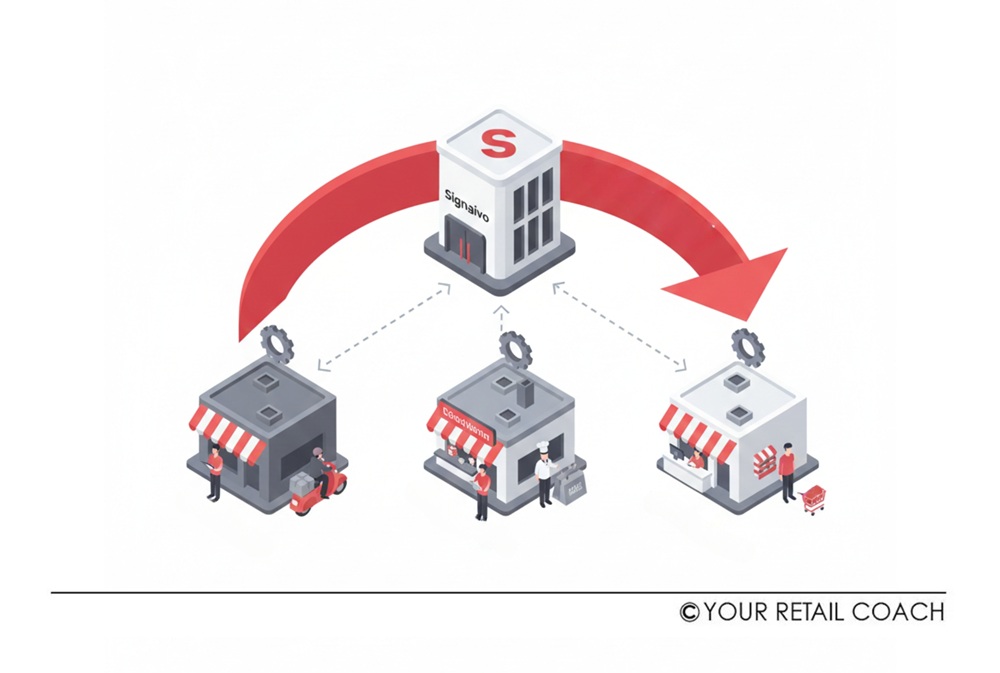
Grocery operations today encompass physical stores, dark stores, and cloud kitchens. Each operates to a different customer segment, but their efficiencies and brand consistency rely on operational standards. This is where Signavio makes a transformational change.
Signavio is a BPM-based process management tool that allows grocery brands to visualize, analyse, and optimize various operational models and workflows. Retail consulting experts use it to add structure to complex systems across multiple locations. Signavio integrates with process automation and ERP systems to allow for coordination and accountability in real-time.
When the SOPs (Standard Operating Procedures) are documented digitally, grocery brands can ensure that all locations are following the same operations blueprint. Signavio consolidates workflow management into a single transparent, data-driven ecosystem, from order processing, to packaging, to delivery.
For e-grocery or hybrid models, this standardisation reduces inefficiencies, audits compliance, and improves scalability. In a rapidly changing retail world, Signavio will help to keep all business models consistent while enabling speed, accuracy, and customer satisfaction.
What Role Does Signavio Play in Multi-Format Grocery Operations
Signavio serves as the central nervous system for grocery operations spanning dark stores, cloud kitchens, and brick-and-mortar outlets, bridging the operational visibility gap and providing relevant structure to all workflows.
Key features include:
- All-In-One Workflow Visibility: Operations across the company can be viewed at-a-glance from one dashboard.
- Process Mapping: Visualisation of tasks, ownership, and interdependencies
- Embedding Procedures: Incorporation of standard procedures within a digital workflow
- BPM Metrics: Measuring process performance for continuous improvement
- ERP Integration: Linking process performance to company financial data.
Retail consulting practitioners take advantage of Signavio for identifying bottlenecks and suggesting improvements in dark stores, cloud kitchens and brick-and-mortar stores: enhancing picking and dispatch in dark stores, coordinating food assembly and preparation in cloud kitchens, and improving product replenishment on-shelves and speed of checkout in brick-and-mortar stores.
By providing the organization and structure to chaos, Signavio succeeds at ensuring that every grocery outlet regardless of format achieves this aim of operating efficiently and precisely.
Standardisation Challenges Across Different Store Models
Operating dark stores, cloud kitchens, and retail stores as part of your brand comes with its own set of operational challenges. Each model operates differently while still contributing to the same customer experience.
Dark stores are focused on speed of delivery for orders thus require error free inventory and dispatch supervision. Cloud kitchens are focused on preparing food to order and coordinating logistics and processing in real-time, whereas the retail store relies on personal engagement and stock availability on the shelf for sales.
When SOPs are not standard, errors and variations come into play every time – resulting in inconsistent performance, incorrect reporting, and a drop in coordination and agility. The consulting experts at the retail space often discover different teams operate isolated systems duplicating efforts and creating confusion. Standard BPM tools like Signavio can simplify the problem by outlining the many steps and governance that take place for every process.
With managing process execution and linkage of ERP systems – grocers and retailers can integrate data relative to inventory, sales, and logistics, creating a higher level of control while increasing agility, allowing flexibility to maintain customer service, while ongoing standardisation builds operational discipline.
Mapping Cross-Format Grocery Workflows with Signavio
The first action in your standardisation process is to map out each workflow that you have in the grocery operation. Signavio helps by visualizing workflows so teams can see where their overlap is, inefficiency is, or gaps.
Here are workflows to map:
Order Fulfilment – The function from a customer order to delivery confirmation.
Inventory Control – Monitoring inventory across all store types.
Supplier Coordination – How to execute the inbound logistics effectively.
Customer Service – Managing complaints or refund requests, or support tickets.
Kitchen Operations – Standardised process for preparation and packaging for cloud kitchens.
Consulting office practitioners will use these process maps to create standardised SOPs, and develop each team owning the SOPs to ensure compliance. BPM drives transparency so that all teams understand their role within the big picture. ERP allows grocery owners to track process health and make informed data driven decisions from their operations.
Mapping and analyzing every action from Signavio reinforces a culture of accountability across departments and store formats irrespective of opinion.
Integrating SOPs into Signavio for Seamless Execution
Standard Operating Procedures (SOPs) form the foundation of standardised grocery operations. As long as SOPs have been incorporated directly into Signavio, it makes compliance easier to adhere to high standards. Each step in the workflow is tracked, recorded, assigned and monitored, ensuring that staff members follow the same process, regardless of store layout.
Retail consulting specialists create SOPs that include components such as stock counts, temperature checks or verifying orders. Once these steps are integrated into Signavio, it becomes available as a new accessibility tool for all employees.
With business process management (BPM) automation, triggering alerts will occur when deviation from the standard has occurred or corrective workflows will begin. Integration of ERP systems will ensure that any actions taken under the SOP mechanism are immediately reflected in business data to preserve visibility.
In the e-grocery or hybrid grocery model, this represents a common service model to address all stores in the grocery setting. Staff at dark stores, kitchen clouds or walkable stores are under common rules and expectations for performance. The net outcome is coordinated and seamless interactions and learning, with fewer errors, all from one digital command centre.
Importance of BPM and ERP Integration in Workflow Consistency
Integrating a BPM tool like Signavio with an ERP system ensures end-to-end workflow consistency and real-time control. This combination connects process execution with business data for complete transparency.
Their combined impact includes:
- Data Synchronization: linking operational steps to financial and inventory data.
- Performance Tracking: Measure workflow efficiency through BPM dashboards.
- Process Automation: Reduce manual dependencies and repetitive tasks.
- Compliance Management: Ensure SOP compliance through automated monitoring.
- Scalability Support: Replicate workflows across multiple store locations.
The retail consulting team configures these integrations to fit grocery-specific operations. the ERP captures the transactional aspects, while the BPM manages the process flow. Together, they eliminate silos and enhance decision making.
How Signavio Transforms Dark Store Efficiency
Dark stores are in the background delivering online grocery customers the speed and accuracy they want. Signavio enables dark stores to drive exceptional efficiency by simplifying how they work together and eliminating wasted time.
ERP system integration guarantees real-time inventory updates, ensuring there is neither excess nor diminished stock of products. Process automation eliminates time lost in communication among departments.
In business terms, this means faster days and hours for e-grocery and lower costs, and better customer satisfaction. Signavio’s methodical process flow reorients dark stores into a slick, coordinated business model for order fulfillment to enable rapid growth and scaling without chaos.
Applying Signavio in Cloud Kitchens and Physical Stores
Signavio’s versatility allows it to be used across digital-first cloud kitchens and conventional brick-and-mortar stores. It guarantees that every operational structure is held to the same level of performance and quality.
There are a few implementation highlights:
Cloud Kitchens: Prepare products on time, prioritizing orders, and delivery management.
Physical Stores: Control stock shelves and billing solutions.
Cross-Department Service: Sync teams with BPM workflows.
Adherence to SOP: Put protocols in place for hygiene, safety, and customer presentation.
Data Analytics: Integrate ERP solutions to track productivity levels at the store.
In addition, retail consulting professionals utilize Signavio to ensure all employees, regardless of setting, access the same process documentation and updates. BPM eliminates delayed manual communication and allows solutions to be resolved faster.
For hybrid grocery networks, this method is a better approach for uniformity, speed, and efficiency while providing transparency. It creates more streamlined collaboration and consistency for the brand through identified operational variances between environments, whether cloud-based or physical.
FAQs About Using Signavio in Grocery Operations
In what ways does Signavio increase efficiency in grocery operations?
What is the significance of standardisation for dark stores and cloud kitchens?
How does grocery consulting influence Signavio implementation?
Is Signavio capable of integrating with ERP systems?
Author Bio

Rupal Agarwal
Chief Strategy Officer


Get In Touch