
Jewellery Marketing Strategy
In the jewellery business, the CRM is not just any other piece of technology; it’s the digital bridge of the relationship between a brand and its customers. It is a specialised software application designed to manage the unique, high-value, emotion-filled, relationship-driven sales (and service) and data-related dependencies and specifications of the jewellery business. In terms of its practical manifestation, it is the techno-operational framework for relationship management in the jewellery business. What it means for business owners and top executives is the brand-level transition from reactive CRM to proactive CRM.
In this blog, YRC’s experienced team of jewellery business consultants explicate the relationship between jewellery CRM and increased repeat purchase and high-ticket conversion with actionable solutions.
Jewellery CRM: How to Increase Repeat Purchases
In the jewellery business, the first sale is often the most difficult to secure because it demands overcoming a massive trust barrier. And once that barrier is broken, it all boils down to the quality of efforts for customer retention and repeat purchase.
Being a long-term and high-value investment, customers seek the credibility of brands and their products. Certification, buyback, and exchange take care of this requirement to a significant extent. But for retention and repeat purchase, more efforts are required – broadly, in the form of service and support, follow-up, incentivisation, innovation, and personalisation. A CRM serves as a brand’s digital memory and communication ecosystem to humanise and automate many crucial operations and elements of customer relationship management.
Here are three recommended alignments that can be achieved with CRM. Another way of looking at these alignments is to seek (and customise) these features when considering the purchase of any CRM application.
Automated Trigger for Personal Life Events
Personal life events like birthdays, anniversaries, and cultural ceremonies and festivals hold special significance to customers. These events are opportunities to encourage purchases. However, waiting for customers to walk into it would be a passive approach. CRM should be able to trigger advance reminders of such events. Doing it manually is unsustainable, even for small businesses that have limited clientele.
Whether or not the exact date of the event is known is not important. If a customer purchased an anniversary jewellery piece on, say, 5th December, the yearly trigger could be set for fifteen days prior. This creates an avenue to bring in customers with tailored offerings, accompanying or augmenting prior purchases.
Due respect to privacy considerations is essential here.
In selecting CRM solutions, the possibility of making such customisations should be ensured.
Transition from Service to Sales
Most jewellery products demand maintenance like prong checking (twice a year on average), rhodium plating (every 1 or 2 years on average), and cleaning (as needed). CRM can track these service intervals across product categories, purchase dates, and customers (again, a manually challenging feat). By sending automated reminders (could be manual in some cases), CRM helps create repeat foot traffic. Jewellery brands often provide complimentary professional cleaning or prong inspection services to bring customers back to stores. Once the efforts of re-engagement transform into something tangible (a store visit, an enquiry call or a website/app visit), it creates an opportunity to create new sales. There is also scope for personalising the touchpoint experience.
Invoking the Wishlist
A wishlist is an ignored garden of delayed desires. But it is also an explicit display of interest in the chosen products. There could be many reasons for an item to be wishlisted and not purchased. The task here is to invoke these saved wishlists. The easiest way out is sending emails or text or app-based instant messages. The best timing for this would be personal life events and during sales and festive seasons.
Today, CRM applications are capable of incorporating such requirements and executing them with precision on scale. With the help of AI-powered analytics, CRM can also help sharpen the strategies and timings.
Veteran fashion jewellery consultants from the luxury retail space would agree that sincerity in communications is very important. Communications should not appear opaque with messages like “now back in stock” or “only 2 left, hurry”.
Jewellery CRM: How to Increase High-Ticket Conversion
High-ticket items are subject to a unique hurdle often referred to as ‘friction of value’. This phenomenon occurs when the price of a product is high enough to deter purchase at the cost of desire. Overcoming this requires a shift from ‘achieving sales’ to demonstrating trust & credibility, meaningful personalisation, compilation of values, social testimony, opportunity cost, and ROI. CRM helps incorporate these measures in an extensive range of ways. Three such examples are given below.
Digital Clienteling
Digital clienteling represents the modern avenue of managing high-end customer relationships in retail. Traditionally, clienteling assets took the form of physical ledgers/diaries comprising customer names, buying history, preferences, etc. In today’s digital age, clienteling assets are data-driven tools that help brands provide a personalised and premium experience. Today, digital clienteling comes as a part and parcel of popular jewellery CRM solutions. One such stand-out CRM feature is discussed below.
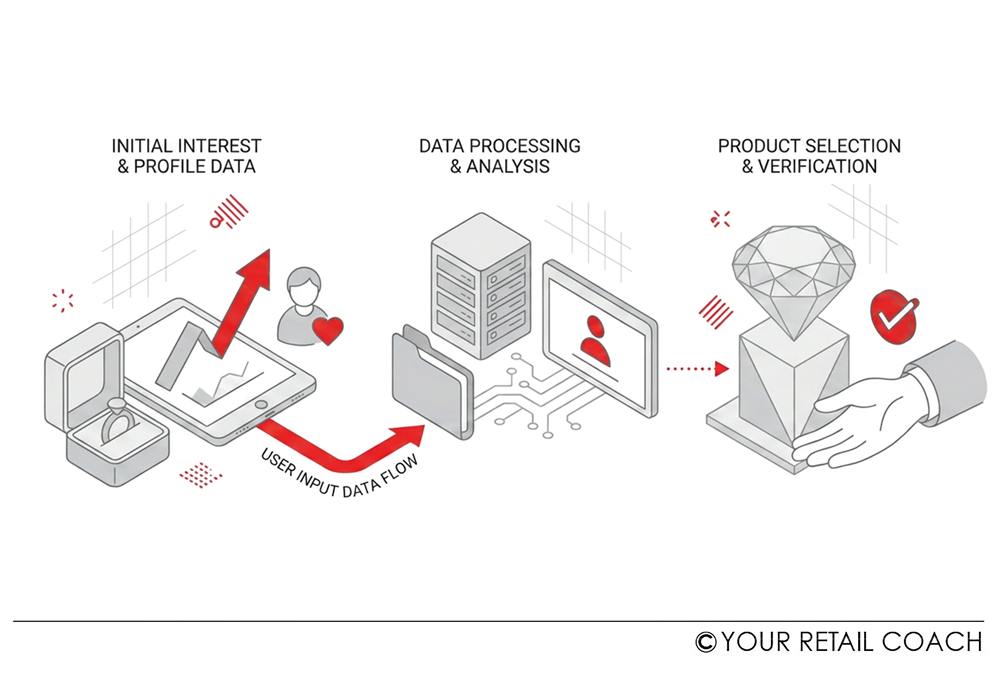
In the context of digital clienteling, CRM offers a single-view, unified customer profile. CRM can track, analyse and display crucial inputs like preferred channels and timing for communication, style and fitment preferences, important dates, and UX trends and patterns. This helps in crafting and delivering high-touch customer-centric experience solutions, and all this while staying within one application.
Centralised Digital Record of Design and Product Catalogue
High-ticket items are often unique or rare in terms of design, craft, and material. A store can’t stock everything it offers. But at the same time, it is also not good to say ‘no’ to clients or make them wait when they visit the store. This is where CRM comes into the picture. It allows store associates to access a centralised record of designs and products. CRM can display high-resolution images and 360® videos and share the content directly to a customer’s registered contact. Even if a particular design is not available at that time or there is a customisation requirement, purchase bookings can be made from CRM. Essentially, with this feature, brands can shift from an ‘out-of-stock’ situation to securing a purchase.
A counter-argument is having all products and designs listed on the brand website or app. High-ticket purchases are rarely made over eCommerce. Customers seek examination and validation. A physical visit and face-to-face interaction is even more important where customers have specific preferences or customisation requirements.
Human Touch in Communications
Sometimes, we may find that professionals like doctors casually ask their patients about their work or family, just as a courtesy or a kind of parallel communication stream. As luxury fashion brand consultants for 10+ years, YRC maintains that such small acts go a long way in strengthening the relationship. CRM serves as a data tool helping businesses exhibit such brand humanisation. Even the basic client details stored in CRM help brands communicate with clients at a slightly more effective level. This is not to create an immediate sales opportunity out of thin air, but to strengthen the relationship for the future. Automated communication should be avoided in such personalisation measures. It defeats the very purpose of ‘humanising’ brand communications. Phone calls are preferable as the first medium.
YRC also recommends emphasising the element of heritage in branding. If you pick any renowned jewellery brand, you will likely notice its jewellery marketing strategy being tilted towards ‘storytelling’ and ‘tradition’ to attract premium clients.
Summarising
In the jewellery business, the CRM is a specialised software application that serves as the digital bridge of the relationship between brands and customers/clients. In today’s age and time, CRM is a key component of a successful jewellery marketing strategy.
Increasing Repeat Purchases
Personal life events are opportunities to encourage purchases. CRM should be able to trigger advance reminders of such events. This creates an avenue to bring in customers with tailored offerings, accompanying or augmenting prior purchases. Due respect to privacy considerations is essential here.
CRM can study wishlists saved by customers and send personalised reminders via email or IM services. This helps invoke forgotten or delayed desires. With the help of AI, CRM can also help sharpen the strategies and timings of such reminders.
Increasing High-Ticket Conversion
Digital clienteling helps brands provide a personalised and premium experience by keeping all client-related details in one place. It comes as a part and parcel of popular jewellery CRM solutions.
CRM allows store associates to access a centralised record of designs and products. It not only helps overcome temporary unavailability, but brands can also turn an ‘out-of-stock’ situation into a secured purchase.
CRM serves as a data tool helping brands exhibit brand humanisation at a more effective level.
Your Retail Coach
We are a global retail & eCommerce consulting marque specialising in business set up, management, and expansion solutions. With more than ten years in business, the team has assisted more than five hundred clients in over 25 sectors with a triumph rate of over 94.2%.
To connect with an experienced jewellery business consultant, let us know and we will shortly reach out to you.
Retail Healthometer
Check the health of your business? Are you ready to organize & scale ?
Author Bio

Nikhil Agarwal
Chief Growth Officer


Get In Touch