
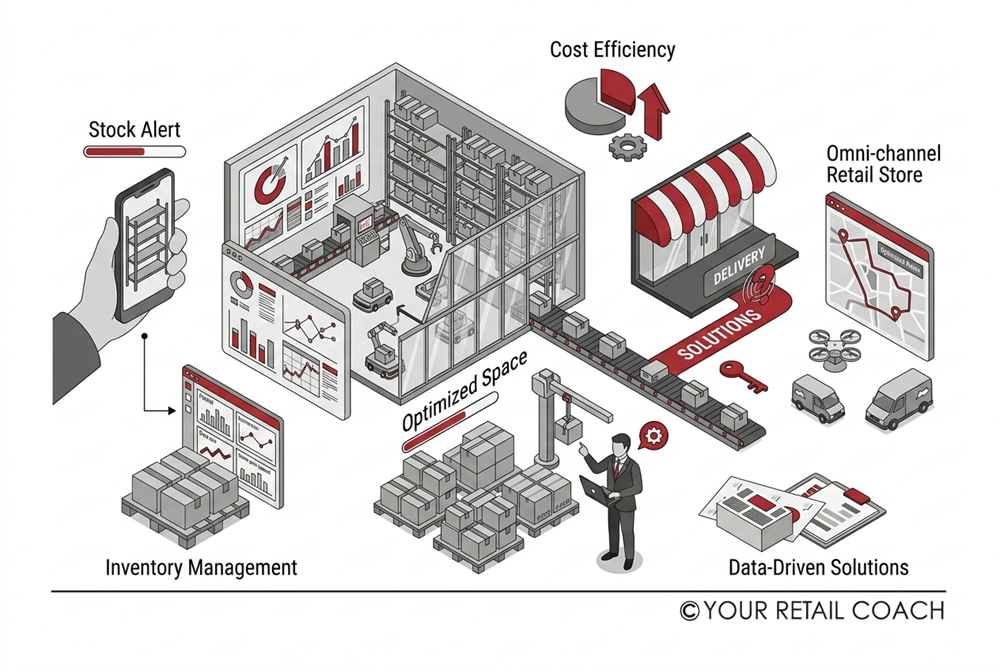
Management of retail warehouse operations can become an uphill task when things like inventory planning, sending out orders and working with stores all happen separately. When retail businesses get bigger and have stores in different places, even small problems in the warehouse can cause big issues. Amidst all this, order fulfillment, having enough stock and making a profit can be an uphill task.
A lot of retailers still use outdated systems for keeping track of inventory and they do a lot of things manually. This makes it hard to see what is going on in the whole supply chain. Retail businesses need to work on this. Efficient retail warehouse operations are very important for businesses.
The solution lies in building process-driven warehouse operations supported by integrated inventory visibility and execution discipline. Retailers need standardized workflows, synchronized replenishment structures, inventory governance frameworks, and technology-enabled warehouse monitoring. A retail wms helps businesses improve inventory tracking, replenishment responsiveness, and warehouse execution consistency across every retail store warehouse.
YRC helps retailers with advice on operations making warehouse processes better. YRC creates standard steps to follow, managing stock levels and strategies to make big changes happen.
They make warehouses better, at handling work help stores see what stock they have and make sure everyone is working together smoothly with a system that manages stock across many stores. This way warehouses and stores can work together effectively. YRCs approach makes it easier for warehouses to grow, have views of their stock and have workflows that fit with how many stores they have.
The main goal is to make sure warehouses and stores are coordinated well using a system that manages stock in stores.
How to Solve Inventory Visibility Challenges in Warehouse Operations
Businesses know that poor inventory visibility is one of the most primary risks in warehouse management. Delayed stock updates and disconnected systems create replenishment errors and inventory mismatches.
Build Centralized Inventory Visibility – Retailers should connect warehouse stock, store inventory, transit inventory, and returns management through a centralized multi store inventory management system.
Key Operational Benefits
- Real-time stock visibility
- Faster replenishment planning
- Reduced stock discrepancies
- Better inventory allocation
- Improved transfer coordination
A connected stores supply warehouse structure improves inventory synchronization across the retail network. Retailers using a retail wms can also monitor inventory movement continuously during receiving, storage, dispatch, and store replenishment.
Eliminate Manual Inventory Tracking – Manual tracking methods increase reconciliation delays and operational dependency. Retailers should automate inventory updates through barcode scanning and system-based stock validation.
Recommended Controls
| Operational Area | Recommended Solution |
|
Receiving |
Barcode validation |
|
Storage movement |
Real-time inventory updates |
|
Dispatch |
Scan-based verification |
|
Transfers |
Automated reconciliation |
|
Cycle counts |
System-generated audit schedules |
A warehouse management system for retail paves the way for reducing manual intervention and improves inventory accuracy across every retail store warehouse.
Strengthen Inventory Governance – Inventory accuracy depends on operational discipline. Retailers should establish clear inventory governance structures across warehouses and stores.
Governance Priorities
- Cycle counting schedules
- Inventory discrepancy escalation
- SKU classification standards
- Transfer approval controls
- Replenishment authorization workflows
YRC supports retailers with inventory governance frameworks, SOP development, warehouse process audits, and operational standardization programs.
How to Solve Fulfillment and Replenishment Delays
Warehouse delays directly affect shelf availability, customer fulfillment, and working capital efficiency.
Optimization of Warehouse Layout and Movement – Poor warehouse layouts can take a toll on picking time and labor dependency. Every retail store warehouse should organize inventory according to movement frequency and replenishment priority.
Recommended Layout Structure
- Fast-moving inventory near dispatch lanes
- Seasonal inventory in overflow zones
- High-value inventory in controlled storage
- Cross-docking for urgent replenishment inventory
A disciplined stores supply warehouse structure reduces unnecessary movement and improves throughput speed. A retail wms also helps optimize picking routes and dispatch sequencing.
Standardize Picking and Dispatch Processes
Inconsistent dispatch execution creates fulfillment delays and shipment errors. Retailers should redesign warehouse workflows around standardized operational controls.
Execution Priorities
- Batch picking for repetitive orders
- Wave planning during peak periods
- Scan-based dispatch verification
- Exception alerts for incomplete orders
- Real-time shipment visibility
A warehouse management system for retail improves dispatch consistency while reducing fulfillment errors across the warehouse network.
Improve Replenishment Coordination Across Stores – Disconnected replenishment planning weakens inventory balancing between locations. Retailers should synchronize warehouse operations with a multi store inventory management system.
This Improves
- Store replenishment speed
- Inventory balancing
- Inter-store transfers
- Seasonal allocation planning
- Omni-channel fulfillment
YRC helps businesses redesign replenishment structures through warehouse process consulting, inventory planning frameworks, and operational workflow alignment. Their consulting also strengthens multi store inventory management across retail networks.
How to Solve Warehouse Scalability and Operational Dependency
Warehouse complexity increases significantly during retail growth, omnichannel expansion, and regional growth.
Reduce Dependency on Manual Processes – Warehouses heavily dependent on manual coordination struggle. Retailers can plan to automate these manual and repeated execution areas.
Areas Suitable for Operational Automation
| Operational Function | Automation Benefit |
|
Barcode scanning |
Faster inventory updates |
|
Dock scheduling |
Better receiving control |
|
Dispatch validation |
Reduced shipment errors |
|
Reporting dashboards |
Faster decision-making |
|
Replenishment alerts |
Improved stock responsiveness |
A retail wms helps retailers improve process visibility while reducing operational dependency on manual coordination.
Standardize SOPs Across Warehouse Operations
Operational inconsistency weakens scalability. Retailers should standardize SOPs across receiving, storage, picking, dispatch, and inventory verification processes.
SOP Areas That Require Standardization
- Receiving workflows
- Put-away procedures
- Picking methods
- Transfer processing
- Cycle counting
- Dispatch verification
YRC specializes in SOP-driven warehouse transformation for retail businesses. Their consulting framework combines process engineering, operational audits, inventory governance, and implementation support.
Monitor Warehouse Performance Through Operational Metrics – Retailers should monitor warehouse productivity using measurable KPIs linked directly to fulfillment and inventory performance.
Critical Warehouse Metrics
- Inventory accuracy
- Dock-to-stock cycle time
- Fill rate
- Picking accuracy
- Dispatch turnaround time
- Order processing speed
- Inventory carrying cost
Leadership teams should review these metrics regularly through the retail wms and multi store inventory management system to improve operational decision-making.
Warehouse Management Improvement Structure
Inventory Visibility Assessment
↓
Warehouse Process Audit
↓
Workflow Standardization
↓
Retail WMS Alignment
↓
Inventory Governance Setup
↓
Replenishment Optimization
↓
Performance Monitoring
↓
Continuous Improvement
Retailers that strengthen warehouse execution improve inventory responsiveness, fulfillment reliability, and operational scalability. A connected stores supply warehouse structure supported by disciplined controls and technology integration improves inventory flow across the business.
Strategic Outcomes for Retail Leaders
Retailers that solve warehouse management challenges improve operational stability and supply chain responsiveness.
Expected Outcomes
- Improved inventory accuracy
- Faster store replenishment
- Reduced fulfillment delays
- Better inventory visibility
- Lower carrying costs
- Improved labor productivity
- Better warehouse scalability
- Stronger replenishment control
YRC supports warehouse transformation through operational consulting, SOP development, inventory management frameworks, and warehouse process redesign. Their consulting practice helps growing retail businesses to improve inventory governance, replenishment efficiency and warehouse expansion.
Retailers also improve operational coordination with a centralized multi store inventory management system linked to a retail wms. For a growth-centric retail store warehouse strategy you want to focus on process discipline and inventory visibility.
Key Takeaways
- A retail warehouse management system makes it easier to see what is in stock, control shipments and get stock when it is needed across the entire warehouse.
- If a retail store warehouse does not keep track of its inventory it can lead to mistakes in stock levels, delayed orders and higher costs for storing extra stock.
- A system that manages inventory for stores, warehouses and shipping channels all in one place helps everything work together smoothly.
- Using the steps for all warehouse tasks reduces the need for special help and makes sure that all stores and warehouses do things the same way.
- Checking barcodes and updating inventory in time makes sure that inventory is accurate and reduces the time it takes to fix mistakes.
- Retailers should set up their warehouses in a way that makes sense based on how items are sold and how important it is to restock them which helps get items out of the warehouse faster.
- Automatic processes for restocking help businesses make sure they have the amount of stock and avoid running out of items.
- Counting inventory regularly is better than doing it once a year to make sure that the warehouse has an accurate count of what is in stock.
- YRC helps retailers improve their warehouse operations by creating procedures giving advice on warehouse processes managing inventory and making sure everything is done the same way.
- To make a warehouse strategy that works for stores, retailers need to use technology that works together, follow strict procedures and have a system that manages inventory, for all stores.
FAQs
What are the biggest challenges in managing a retail store warehouse?
The major challenges associated with a retail store warehouse include inventory inaccuracies, delayed replenishment, and warehouse congestion. Additionally, poor stock visibility, inconsistent workflows, and fulfillment delays add to the problems. Retailers also struggle with siloed systems across stores and warehouses. Without technology integration and structured controls, operational inefficiencies can grow to a huge extent. YRC solves these challenges through warehouse process consulting, SOP development, inventory governance frameworks and operational standardization initiatives.
How does a retail wms improve warehouse operations?
A retail wms improves warehouse operations by providing real-time inventory visibility, barcode-based stock tracking, and dispatch validation. So, also it ably helps with replenishment monitoring and automated reporting. It offers support against manual errors, improves picking accuracy, and strengthens inventory control across warehouse operations. YRC supports businesses in aligning warehouse workflows with retail wms implementation. This is achieved with process redesign, SOP engineering, and operational readiness consulting.
Why is a multi store inventory management system important for retailers?
A multi store inventory management system allows retailers to synchronize inventory visibility across stores, warehouses, and other fulfillment channels. This improves replenishment planning, inventory balancing, and transfer management. The omnichannel fulfillment coordination improves as well. Retailers are able to make faster allocation decisions while reducing stock discrepancies and overstock situations. YRC helps businesses implement structured inventory management frameworks that strengthen inventory flow and visibility across multi-location retail networks.
How does a warehouse management system for retail improve fulfillment accuracy?
A warehouse management system for retail improves fulfillment accuracy through scan-based inventory verification, automated dispatch workflows, and real-time stock updates. It reduces shipment errors, incomplete orders, and inventory mismatches during warehouse operations. Businesses also gain stronger replenishment responsiveness and dispatch consistency due to the system. YRC supports retailers with warehouse process optimization, inventory workflow alignment, and implementation-focused consulting for retail warehouse transformation projects.
How does YRC help retailers solve warehouse management challenges?
YRC supports retailers in overcoming warehouse management challenges through operational consulting, warehouse audits, and SOP development. The team also provides support for inventory management frameworks, process standardization and warehouse workflow redesign. In terms of their consulting methodology, it is focused on practical implementation and long-term operational growth rather than just advisory recommendations. YRC also offers assistance with inventory governance, replenishment planning, optimization of warehouse processes, and other factors.
Retail Healthometer
Check the health of your business? Are you ready to organize & scale ?
Author Bio

Nikhil Agarwal
Chief Growth Officer