
Why are we talking about it?
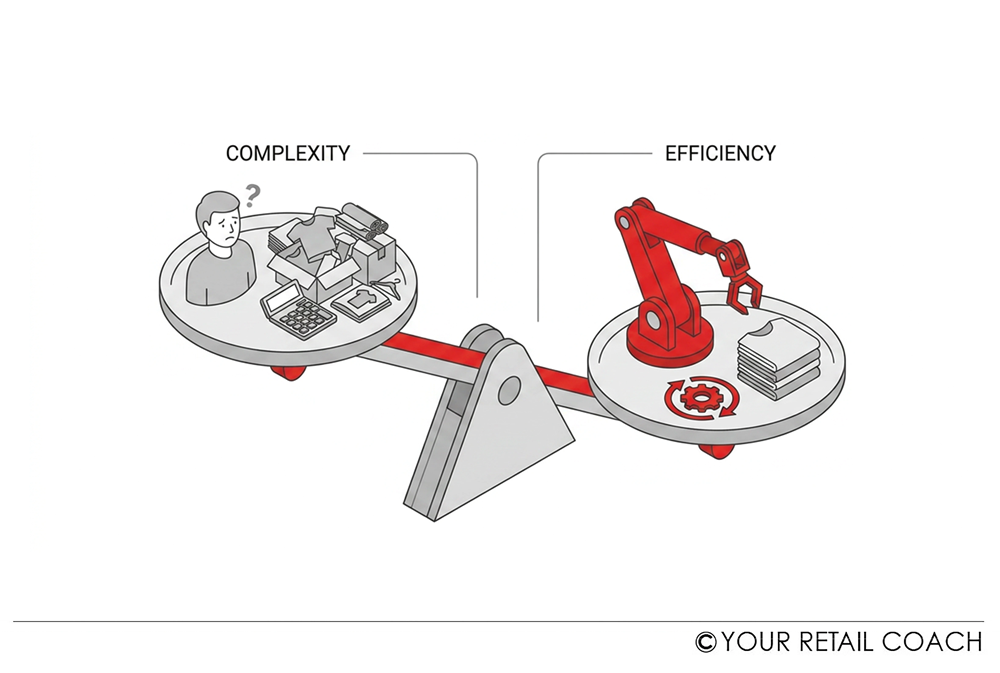
While there is a lot of clamour about AI and automation nowadays, not many people can precisely tell what or which part of their lives they want to automate or let AI control. It is easy to catch feelings, but hard to actually make them a part of life. The story is not much different for retailers who hear as much about automation and want to use it, but are unclear when it comes to pinpointing what exactly they should automate in the management of retail operations.
Many retailers or those in positions of influence in organisations often lack the technical insights and implications of AI or automation, which hampers the vision and implementation roadmap. For example, without the understanding of how AI chatbots learn and work behind the scenes, the implications on customer experience might not be well-conceived.
Many times, decisions are mistakenly driven by “let’s automate” rather than “what business value automation could bring”, like improvement in demand forecasting or quicker redressal to grievances. Then there is the dilemma of whether to keep cost-saving as an objective for automation or increase in revenue. Retailers also cannot make the automation decision in isolation, as automating one process often carries implications for other retail business processes.
Another challenge is the use of legacy and disparate software systems. Outdated technologies and variances in data management across platforms make the job of AI and automation more complicated. Even in the existing software systems, the problem of missing data and data inconsistency is always there. AI cannot make reliable predictions or assist in intelligent process automation with flaws in data inputs.
Explainability and interpretability are two core principles behind every AI product. If there is any shortcoming in these parameters or if business users fail to understand the AI recommendations or actions, they might feel reluctant to rely on AI.
Conceiving or implementing AI and automation solutions is extremely challenging in an undefined operations framework. If business processes are not well-defined or are subject to arbitrary human influence, it becomes more challenging to communicate with AI-powered software systems for process automation. The same is true when business processes are not standardised. For example, if you do not have a definite action plan for making a personalised cup of tea, how are you going to teach an AI robot to do it for you? The same logic holds when it comes to automating operations management in retail stores and warehouses with solutions powered by AI and ML.
AI is a new phenomenon, and no one knows how it is going to pan out in the near future. Retailers are also in the same quandary. Shifting to modern AI-powered automation solutions means saying goodbye to the old, reliable ways of doing business. So, it is easy to understand why so many businesses are adopting a careful approach instead of jumping fully into it. For many, the common way to put it would be – “AI is not there yet”.
Retailers also perceive that it is not easy to see the returns from AI and automation. No one guarantees 100% results from AI and automation solutions, like improved accuracy in demand forecasting or personalisation at scale. Quality AI is still an expensive affair. Speak of customised solutions, and the willingness only withers.
In this blog, the team of retail operations consultants of YRC highlights the areas which retailers should consider wrapping under cutting-edge automation solutions.
Inventory Management (Certain Processes)
Inventory management is one such area in which AI and automation have a tremendous impact. Within inventory management, three tasks that should be executed with AI and automation are demand prediction, replenishment, and waste minimisation.
Demand Prediction: AI can analyse large datasets drawing from historical sales, festive factors, promotional campaigns, local events, social media trends, and even weather to predict demand for individual products at granular levels.
Automatic Replenishment with Adjustments: While automation can initiate reorders with zero to minimal human intervention, AI can go a few steps ahead. It can calculate timelines and schedule deliveries based on prevailing factors and use updated sales data and demand forecasts to adjust replenishment schedules.
Waste Minimisation: What humans can learn over months, AI can achieve the same in a very short time. This is extremely useful for reducing wastage in retail inventory management. For example, it can take some time for a retailer to have a rough idea of the sales of certain products. With the right data, AI can quickly predict the demand and shelf life of products and improvise reorders or replenishment decisions to contain wastage and returns.
Inventory Calculation: By simply feeding images or live videos of shelves and racks in stores as well as in warehouses, AI can easily measure inventory levels. This significantly reduces the human burden of recording inventory data while lending more speed and accuracy to this operation. Smart shelves are a more expensive option.
Customer Service and Support
With customer experience becoming a differentiating factor of growing intensity, the fallout of this on customer service is understandable. So, speaking of customer experience, customer service is not a distant area to concentrate on. But why move from human-run customer service and support systems to solutions driven by AI and automation? One of the brutal reasons is cost. For many brands, it makes the business case to shift to AI-powered solutions for basic customer support and services, instead of relying heavily on manned teams for the same rudimentary tasks. Also, AI is getting better by the day in Natural Language Processing and Large Language Models. For example, quality AI-powered chatbots can have an indistinguishable conversation with a human customer at a basic level. For more advanced or complex queries, real humans from customer support may have to intervene (Intelligent Routing).
However, retailers must also keep in mind that despite AI’s progress in recent times, it is still not equivalent to human touch. Every aspect of a brand speaks for it, but when a customer reaches out for support or when a brand reaches out to customers, the game reaches another level. At this level, it is direct communication. Anything going wrong here directly affects customer experience and possibly their loyalty to a brand. For instance, not all kinds of customers will find talking to a sloppy chatbot respectful. So, you must really know who your customers are and what you mean to them as a brand. Brands like Amazon still have a solid, manned customer support team available to speak to their customers at any time.
Personalisation at Scale
Personalisation might be a new word, but it is not a new phenomenon. Traditionally, it was common for retailers to speak to customers in a personalised way or offer additional discounts to their existing customers. Those were simple times and may qualify as personalisation without the necessity of being treated as a business tactic. Today, the same old ‘personalisation’ has re-emerged as old wine in a new bottle. The underlying truth is that personalisation works. Today, as a retail brand, you might be dealing with hundreds or thousands of customers. It is not feasible for you to know each one of them and create personalised solutions manually. This is where AI and automation come into the picture. Technology can get it done for you, what you may personally want as a business owner, a senior executive or a board member of a retail brand.
Making Product Recommendations
To arrive at better recommendations, AI algorithms are trained to analyse a wide range of datasets like browsing history, clicks, sessions, past purchases, methods of payment used, wish-listed items, abandoned carts, reviews and ratings, and date and time stamps of actions. These internal business data are readily available, making it easier for retail brands to find a suitable AI product or use the features already available in their existing CRM applications.
Targeted Outreach
AI and automation boost the ability to reach out to customers with higher accuracy and timeliness. It goes beyond generalised promotion and can deliver hyper-personalisation solutions. AI trespasses traditional segmentation styles like the ones based on age or gender and can classify segments on numerous niche, dynamic, and predictive factors. For example, in behavioural clustering, AI can read into tons of data to correlate consumer behaviour with affirmative actions and classify customers into highly specific groups. Similarly, in predictive modelling, AI can predict the likelihood of future actions, like the predisposition to make a purchase or create an abandoned cart. This also helps in identifying high CLV customers and investing in such prospects.
As experienced retail business process consultants, YRC maintains that, presently, there is no better solution than the ones offered by AI and automation that could better deliver hyper-personalised content and recommendations at scale. In addition to personalised product recommendations, AI can also personalise content visible to individual users/customers on websites, apps, and social media advertisements. AI is also good at generating personalised messages at a large scale with diversity to curate specifically for individual customers. Such a degree of personalisation makes a brand and its offerings more relevant to customers. For example, a customer’s past purchase history may show that only such products are bought which have a sufficient number of images in the product description. Now, it becomes clear that in recommending products to that customer, such products should find prominence which have more images in their product description.
Dynamic Pricing
AI and automation can be a game-changer for retailers as they can replace guesswork and sporadic price changes with real-time, data-driven, and automated price adjustments towards optimising revenue and profitability. AI models can process large, diverse, and real-time internal and external data like inventory levels, sales patterns, price elasticity, market prices, and even local events to adjust prices multiple times. AI can establish a data-based, logical relationship between price changes and the resulting changes in demand for each product across different customer segments. AI not just seeks to increase sales but also finds the price points that can optimise the revenue levels.
Based on the recommendations put forward by AI models, automation tools can give effect to the price changes across all sales channels instantly without the need for any human to intervene in the process. For safety, retailers can also limit what AI models can recommend so that there are no adverse outcomes. For instance, one condition could be that the recommended price never goes below a certain point. Similarly, in the case of perishable or seasonal products, instructions can be given to AI models to ensure that such goods get sold on time based on how fast the sales are going and the demand forecasts.
In-Store and Warehouse Operations
AI and automation can significantly elevate the quality of retail operations management in stores and warehouses. For instance, in inventory and shelf management, AI robots powered with vision can scan racks and shelves to identify out-of-stock items, misplaced items, incorrect display tags, or any other anomaly. AI vision can also help detect suspicious or abnormal activities something that is necessary for preventing inventory shrinkage. AI-powered checkout solutions are also a league ahead in executing frictionless checkout, also contributing to improvement in customer experience and achieving efficiency in staff deployment.
Wrapping Up
Why the dilemma in AI automation? Oftentimes, retailers are unclear about what exactly they should be automating in the management of retail operations. The ones in positions of influence in organisations often lack the technical insights and implications of AI or automation, which hampers the vision and implementation roadmap. Many times, decisions are mistakenly driven by “let’s automate” rather than “what business value automation could bring”, like improvement in demand forecasting or quicker redressal to grievances. Existing outdated technologies and variances in data management across platforms make the job of AI and automation even more complicated. Also, conceiving or implementing AI and automation solutions is extremely challenging in an undefined operations framework. Shifting to modern AI-powered automation solutions means saying goodbye to the old, reliable ways of doing business which partially explains why so many businesses are adopting a careful approach instead of jumping fully into AI. Cutting through these common doubts and concerns, this blog highlights the areas which retailers should consider wrapping under cutting-edge automation solutions.
Within inventory management, three tasks that should be executed with AI and automation are demand prediction replenishment, and waste minimisation
Costing is one of the strongest reasons for moving from human-run customer service and support systems to solutions driven by AI and automation. However, retailers must also keep in mind that despite AI’s progress in recent times, it is still not equivalent to human touch.
‘Personalisation’ has re-emerged as old wine in a new bottle. It is not feasible for brands to manually study and create personalised solutions for hundreds or thousands of customers. This is where AI and automation come into the picture. On the same lines, AI algorithms and automation are also highly efficient in making product recommendations at scale with data-based decision-making.
AI and automation boost help in targeted outreach to a massive audience with higher accuracy and timeliness. AI goes beyond generalised promotion and can deliver hyper-personalisation solutions. AI trespasses traditional segmentation styles like the ones based on age or gender and can classify segments on numerous niche, dynamic, and predictive factors.
AI can also personalise content visible to individual users/customers on websites, apps, and social media advertisements.
AI and automation can be a game-changer, optimising revenue and profitability by means of dynamic pricing wherein AI replaces guesswork and sporadic price changes with real-time, data-driven, and automated price adjustments.
AI and automation can significantly elevate the quality of retail operations management in stores and warehouses by improving areas like demand forecasting, reorder scheduling, and loss prevention.
About Your Retail Coach
We are retail & eCommerce consultants with a scaling international presence. Over 10+ years of experience in retail and eCommerce consultancy, we have catered to over 500 clients in over 25 sectors with a success rate of 95%.
To speak to a professional retail store operations management consultant, feel free to drop us a message, and we will shortly reach out to you.
Retail Healthometer
Check the health of your business? Are you ready to organize & scale ?
Author Bio

Nikhil Agarwal
Chief Growth Officer


Get In Touch