

Dive In
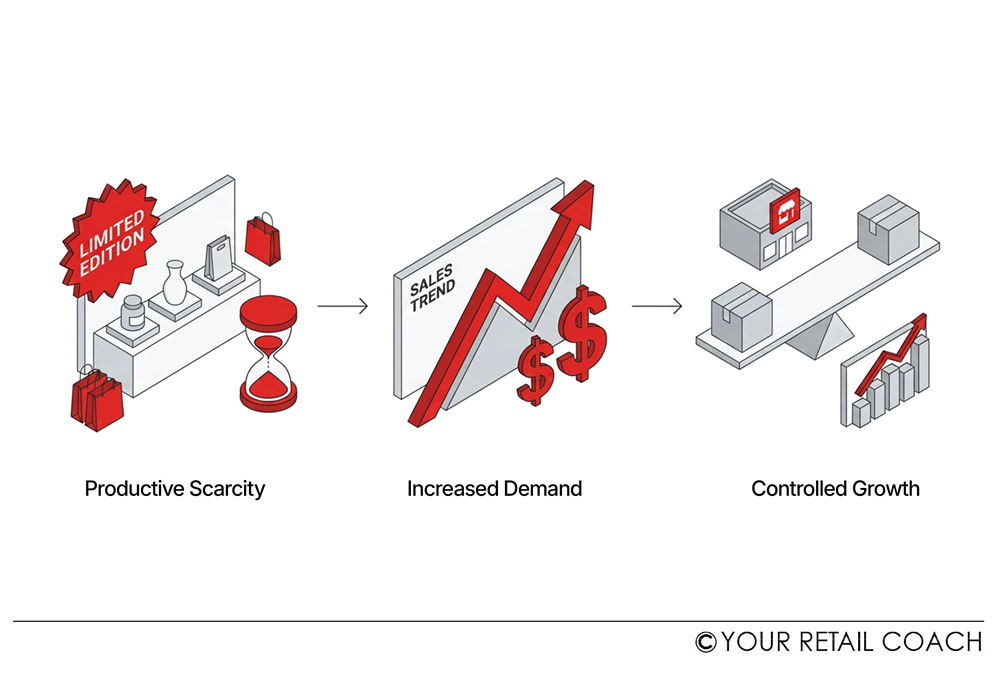
Creating a sense and environment of productive scarcity is a powerful strategy in retail as well as eCommerce that taps into consumer psychology. This involves curbing the obtainability of products with the motto of creating a perception of exclusivity and specialness and triggering desire and urgency. However, this strategy may also backfire and put brands in a poor light. Therefore, it is important to understand the nuances of this strategy for getting the desired results. This blog seeks to explain the working of the psychology of scarcity in retail, its execution, and the related risks and rewards.
How the psychology of scarcity works in retail
Higher Perceived Value = Willingness to Pay a Higher Price
The rarity of something often leads us to assume that it must be some kind of hidden gem. This hard-to-get perception tends to work almost universally. For example, during the 2020 pandemic, there was a shortage of many routine-use household products in the market. As a result, consumers bought such products in larger quantities whenever they had access to them. Although that supply chain situation was beyond anyone’s control, the same sense of hard-to-get perception is capable of being applied as a productive strategy. In such a situation, there is also a tendency to pay a higher price. The tricky part here is that it is difficult to read what is happening in the minds of customers as a whole. This is always a risk of customers shifting to alternate products or even losing interest or giving up looking for such products.
Quick Buying = Bypasses Standard Decision-Making Process
Limited availability creates a sense of compulsion for making purchases with less thinking and more emphasis on having safety stock. In other words, this makes the purchase decision-making process simpler for customers, which also benefits retailers with sales becoming easier. For example, there was a global shortage of graphics cards in 2021, which eventually took some time to stabilise. The prices of graphics cards skyrocketed in global markets, and that too with limited availability. Those who needed to buy bought with little haste, even at inflated prices. Consumers had little time to react, and if they were late in making a decision, the items would again run out of stock within a matter of a few hours and sometimes even minutes.
Limited Availability = Product Exclusiveness = Proud Ownership
Going back to our school days, we may recall that having a different and unique pencil or schoolbag that no one else had in the class gave us a sense of pride and exclusiveness. With age, such perceptions tend to disappear from the surface but continue to exist deep down inside us. A simple example of this is smartphones. We can talk about iPhones, but that is not the point; it is about the limited availability of a product, which makes it unique and exclusive. For example, if a smartphone brand launches a limited-edition variant, that would fit into the idea of exclusiveness.
The Impact of Social Media
Uniqueness or exclusiveness is a common denominator for both creating viral content and creating viral demand. If you are a social media enthusiast and you have something that is rare, limited, or hard to get, you may not mind flashing it on your social media handles. Although nowadays people tend to keep their personal lives a bit private, everyone does not think that way. And if an account is private with say 100 followers comprising close family and friends only, the tendency to share ownership of such products is even more likely. Among those 100 followers who viewed that post are likely to see it as a symbol of social validation and acceptance to enjoy such exclusive ownership.
Creating Productive Scarcity in Retail
Limited-Edition
Scores of retail brands deploy the limited-edition strategy to generate an aura of rarity and exclusivity for their offerings. In this strategy, a special version of a product (could be a new product as well) is released, but in limited numbers. It is common to see renowned brands coming up with limited-edition products from time to time. Even though the underlying strategic objectives cannot be established, this limited-edition strategy also helps brands keep customers interested and engaged. For example, a soft drink brand may come up with a special edition flavour or packaging aligning with any global sports event. The essence of ‘limited-edition’ is so powerful that some retailers use it as a retail development strategy and perpetually keep their supply levels limited while ensuring it does not frustrate their customers.
Collaborations
Very close to the essence of limited-edition is the strategy of collaborating with another brand, artist, sportsperson, or celebrity and offering a curated and limited collection. This is different from celebrities endorsing brands. Brand endorsement need not necessarily create any new product/design, but collaborations do. Brand endorsement is for general promotional purposes; collaborations revolve around a new and curated line of collections. For example, a footwear brand may collaborate with any sportsperson to come up with limited-edition sports shoes. Whether by design or default, collaborations and limited collections end up creating both exclusivity and a productive scarcity. This collaboration strategy should also not be confused with collaboration with social media influencers; brands do not create any new product lines here.
Surprise Product Launches
Launching new products without prior notice often takes customers by surprise. It is hard to ignore such product drops, and it creates a sense of urgency for checking out or even purchasing. The element of sudden availability, in a way, teases us as buyers. The popularity of the brand in question is a big factor here. The product drop strategy has a small window of time for making its magic work. The speed and accuracy of advertising on digital platforms play a crucial role here. Product drop strategy works well in industries where innovation is possible in quick intervals. Smartphone and electronic accessory brands are prime examples here. Fashion brands can also use the product drop strategy, as quick innovation in fashion design is possible.
Time-Bound Offerings
When a quality and relevant product is offered for a limited period, it creates a sense of scarcity. After this period is over, the product will no longer be available. If action (purchase) is not taken during this timeframe, it could turn out to be a missed opportunity. This phenomenon is also referred to as FOMO (Fear Of Missing Out). Since human psychology seeks loss aversion, it increases the chances of making a purchase during time-bound offers. Of course, there are other variables at play here, but such offers seek to leverage this FOMO aspect of human psychology. For example, food aggregators may use it during live sports events where special discounts are provided when any special feat is achieved in a game, like hitting a boundary in a cricket match.
Membership and Exclusive Access (Decreasing Impact)
When Gmail (email service) was first made available to the general public globally, it required an invitation from an existing Gmail account holder. This created a sense of scarcity and exclusivity in a world that was stepping into an era of digital communication driven by the internet. If the product is right, scarcity and exclusivity still hold that charisma.
With expertise in contemporary strategic retail consulting solutions, YRC maintains that in today’s competitive backdrop, membership and exclusive access features do not have the same influence as they used to have a decade back, barring a few sectors or product segments and that too in premium categories only.
Important Considerations
The most significant requisite for the scarcity principle to work is resonance with the target audience. The idea of scarcity and exclusivity assumes slightly altered shapes for different segments.
Brand recognition plays a vital role in the success of the scarcity strategy. Although it is not a watertight requirement when renowned brands do it, the impact tends to be stronger than what is achieved by less popular brands and businesses.
The relevance and perceived value of the product in question is another big factor. Even a big brand can fail to create the desired results from the scarcity principle if the product is not relevant or customers do not perceive it as something worth the hype and covet.
The scarcity principle demands a tactful approach. Doing it with a thudding undertone can send all the wrong signals and backfire. Also, it itself demands scarcity. Doing it too much or too often keeps making it less attractive over time.
Sometimes competitors can also hop in and reap the benefits by launching alternative or similar products within a short time. As one of the experienced retail strategy consulting firms in the industry, YRC underscores uniqueness and difficulty in replication as critical factors in deriving the best results from productive scarcity and exclusivity in retail.
Wrapping Up
Essence
Restricting or limiting the availability of products elicits a sense of scarcity, exclusivity, and specialness that is capable of triggering desire and urgency for making a purchase.
Psychology
The rarity of something and a hard-to-get perception create a willingness to pay a higher price and even buy in larger quantities in some cases. Limited availability makes the purchase decision-making process simpler and quicker for customers, which also benefits retailers with sales becoming easier. Products known to have limited availability also provide a sense of ownership pride. Social sharing makes the ownership of coveted products even more compelling.
Strategies
Scores of retail brands use the limited-edition strategy for creating an aura of rarity and exclusiveness for their products, where a special version of a product (which could be a new product as well) is released but in limited numbers.
Collaborating with another brand, artist, sportsperson, or celebrity and offering a curated and limited collection ends up creating both exclusivity and a productive scarcity.
When new products are launched without prior notice, it teases us as consumers and creates a sense of urgency for checking out or even making a purchase.
Time-bound offerings create a sense of FOMO (Fear Of Missing Out). If action (purchase) is not taken during the stated timeframe, it could turn out to be a missed opportunity.
In today’s competitive backdrop, membership and exclusive access features do not have the same influence as they used to have a decade back, barring a few exceptions like premium segments.
Points to Consider
The most significant requisite for the scarcity principle to work is resonance with the target audience.
Although brand recognition is not an essential requirement, when renowned brands do it, the impact tends to be stronger.
The scarcity principle does not work if the product in question is not relevant or if customers do not perceive it as something worth the hype and covet.
The scarcity principle demands a tactful approach, and overindulgence in it should be avoided.
If the product does not have uniqueness and difficulty in replication, competitors might take advantage.
About Your Retail Coach
We are a retail & eCommerce consulting marque with 10+ years of service excellence having catered to over 500 clients from more than 25 sectors with a success ratio of over 95%. Today, we have service presence in more than 15 countries.
To speak to a retail strategy consulting professional, let us know over a message and we will shortly reach out to you.
For more on retail business strategy solutions, please explore our service pages.
Retail Healthometer
Check the health of your business? Are you ready to organize & scale ?
Author Bio

Nikhil Agarwal
Chief Growth Officer
Nikhil is a calm and composed individual who has a master’s degree in international business and finance from the United Kingdom. Nikhil Agarwal has worked with 300+ retail e-commerce brands and companies from various sectors, since 2012, to define their growth strategy and achieve operational excellence. Nikhil & his team have remarkable success stories of helping brands achieve 10X growth.