
SOPs for an Apparel Brands Operations
No matter if a customer is shopping at a flagship location in New York City or in a small boutique in Mumbai, they expect to find the same shopping experience from the stores they visit: clean organized shelves, visually appealing displays, and an effortless transaction process. However, there are many retailers that cannot deliver a consistent retail experience.
Creating an Apparel Standard Operating Procedure Manual is critical for retailers in order to document all operational details, thus eliminating the guessing game and allowing for retailers to grow effectively.
This article will share how structured processes enable retailers to convert retail chaos into clarity through a practical problem-solution approach. If you are developing or updating your clothing brand’s SOP manual, this guide can help you develop an SOP for your apparel retail store based on effective practices.
Avoid The Beginning When Growth Creates Chaos
A mid-sized apparel brand had just begun to expand to the global markets. Initially, growth felt like success but cracks soon appeared. Each store operated differently, and outcomes varied widely.
- Store teams interpreted processes differently
- Inventory mismatches became frequent
- Visual merchandising lacked brand consistency
- Sales teams handled customers in inconsistent ways
The absence of a structured retail store SOP apparel system created confusion. Store managers relied on personal judgment instead of standardized practices. What worked in one store failed in another. Leadership realized that scaling without a defined apparel SOP manual was like building on unstable ground. The brand needed alignment and not just ambition to sustain its growth.
Identifying the Core Problem
The investigation carried out by management revealed that the core problem was an absence of standardized processes. All divisions operated independently from each other.
- Inventory groups tracked items differently.
- VM teams had inconsistent display guidelines.
- Sales people had no common guidelines on how to interact with customers.
- Returns were processed differently at many locations.
Due to a lack of a comprehensive Clothing Brand SOP, many business decisions were reactive, as opposed to strategic, causing an accumulation of errors and loss of potential revenues along with the potential for harm to our brand’s image. The lack of clarity about what constituted boosted uncertainty among employees regarding performance standards. The issue was not attributed to lack of effort; it was attributed to lack of organization. What this brand needed was one accurate set of information from which to determine the way that every store should be run.
Building an Apparel SOP Manual
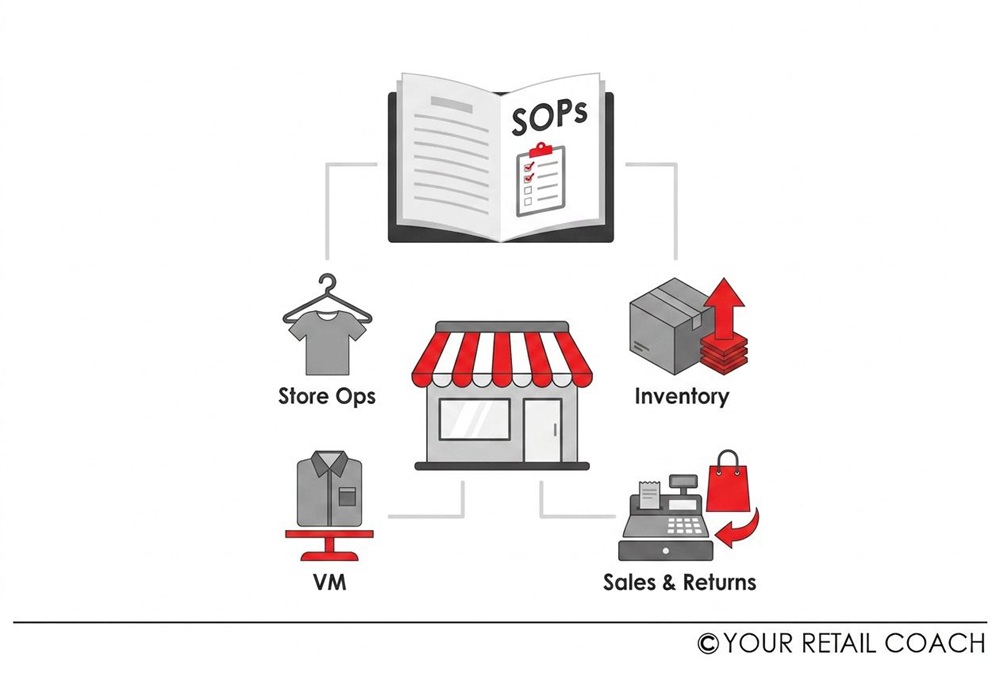
The organization made a commitment to create a full apparel Standard Operating Procedure manual – which would outline all critical processes. In terms of development, the SOPs were not just a means of documentation, but rather, part of a departmentally-inspired transformation initiative.
Some of the objectives included:
- Creating a map for every aspect of the store operations
- Creating consistent workflows across the organization
- Clearly defining roles and responsibilities
- Establishing performance measures that were quantifiable
Each process was defined in such a way that each employee in the store business unit could follow all procedures. The overall goal of the manual was to eliminate any ambiguity in the operational procedures of the retail store apparel operations. Through a structured retail store SOP program, the organization will be able to ensure that all of its retail stores operate at the same level of operational excellence, regardless of geographic location.
Store Operations SOP for Creating Daily Discipline
Retail success is frequently dependent on store operations. The brand created Structured SOPs to provide uniformity in the way that each store operated on a daily basis.
Key Elements included:
- Opening and Closing Checklists
- Staff Grooming Standards and Conduct Standards
- Floor Supervision Procedures
- Guidelines for Escalating Problems
These processes provided for the store manager to provide the same opening and closing process at the beginning and end of each day. Thus, no longer were managers relying on their memory or their own creativity to ensure they provided an adequate Opening Process or Closing Process. Managers now followed a Structured SOP for the clothing brand, which ensured operation was clearly defined to all employees.
As time passed, the consistency of these processes achieved greater efficiencies and reduced errors. Further, with defined expectations for each employee, employees had greater confidence in their ability to exceed expectations. This also made it much easier to measure, assess and develop the performance of each employee.
Inventory SOP
Inventory is the foundation of an apparel business; without strict controls there is little chance for a business to be profitable. The company developed and implemented a comprehensive inventory Standard Operating Procedure to remove any variations.
The components of the SOP focused on:
- Real-Time Inventory Tracking Systems
- Routine Cycle Counts
- Routine Audits
- Receiving/ Dispatch Protocols
- Shrinkage Prevention
By standardizing these processes, the results showed a reduction in stock mismatches. Additionally, through posting an SOP manual for the apparel division, every single store had the same protocols for handling their inventory. This helped improve both accuracy and product availability to the customer. With better controls, the company was able to make better purchasing decisions to eliminate unnecessary losses.
Visual Merchandising SOP
Visual merchandising (VM) is essentially the brand’s means of communicating without words. However, the inconsistency of VM across stores has diluted the brand’s identity. To address this critical issue, a structured VM standard operating procedure (SOP) was developed.
The major components of the SOP included:
– Seasonal display guidelines
– Standardized product placement rules
– Lighting and signing protocols
– Window display framework
These guidelines ensured that each store reflected the same brand story. The retail store SOP apparel approach transformed VM from the subjective, creative process to a strategic method of execution. Although there remains creativity, it is now limited to the defined boundaries. The result has been an established and memorable in-store experience that has aided in generating worldwide brand awareness and consumer engagement.
Sales SOP for Structuring Customer Experience
Sales interactions are key to how customers perceive the brand. Prior to having a structure in place, experiences were inconsistent. The brand established a sales SOP that creates standardized engagement across the customer experience.
The SOP included:
- Techniques for greeting and engaging with customers
- Frameworks for recommending products
- Methods for upselling and cross-selling products
- Processes for billing and checking out customers
By implementing the clothing brand SOP, a consistent experience for every customer was created, resulting in increased confidence and effectiveness of sales teams due to clear guidelines. Over time, conversion rates improved and customer satisfaction levels increased. Plus, the SOP did not restrict the personalization of interactions. It enhanced the ability to create meaningful interactions through the foundation of the process.
Returns SOP
While many businesses consider the return process as somewhat challenging, if executed correctly, return processes can help establish trust with consumers. To ensure the return process is both fair and efficient, the organization built a return SOP.
Some of the key components of the return SOP are:
- Establishing return eligibility requirements
- Standardizing the inspection process</li
- Defining refund timelines
- Establishing customer communications protocols
Having structured the return process with an apparel SOP manual, returns became predictable and consumer-friendly. Customers experienced professionalism and clarity rather than confusion and wait time. In addition to minimizing disputes, this created brand loyalty. Therefore, a structured return process transformed what could have been a negative experience into a positive customer experience, thereby reinforcing customer trust in the organisation.
Why YRC
With a reputation as a reliable partner, YRC creates high impact SOP Frameworks for the Apparel retail industry. As experts in turning complex operational processes into scalable systems, YRC takes a holistic approach to your business. By combining an in-depth understanding of the retail industry with a structured methodology, YRC produces comprehensive and easily-adoptable SOPs.
Utilizing a hands-on methodology, YRC works with each partner to ensure all store operations, inventory management, visual merchandising, sales and returns align to support the company’s goals.
For companies looking to scale up without issues, using an SOP framework developed by YRC will allow each company’s processes to be a competitive advantage instead of an obstacle.
Retail Healthometer
Check the health of your business? Are you ready to organize & scale ?
Author Bio

Nikhil Agarwal
Chief Growth Officer


Get In Touch