
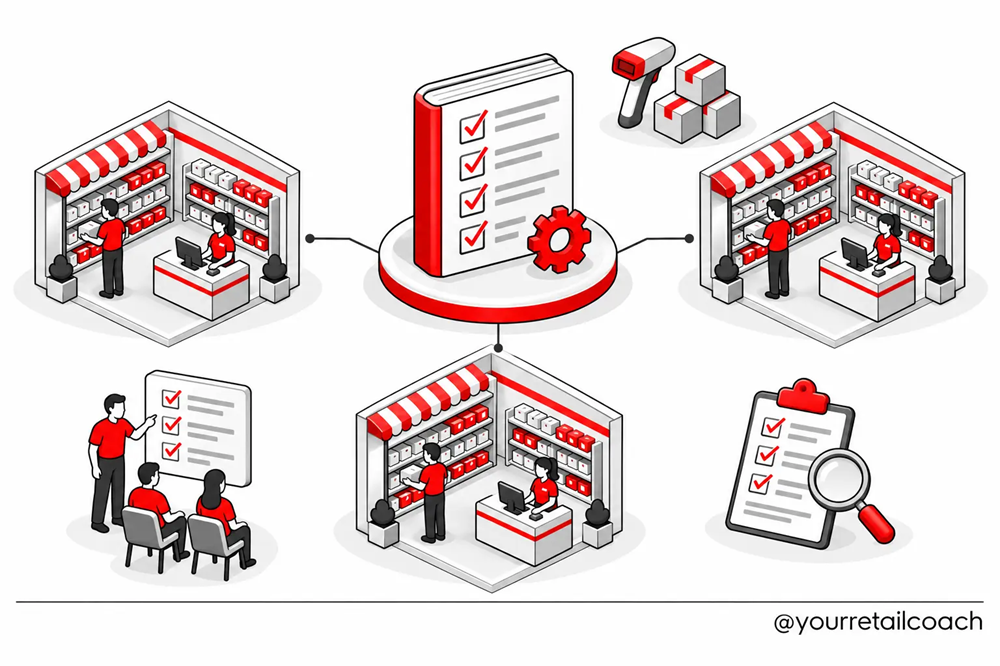
It is a good thing if everyone at home appreciates that you can make a good cup of tea. But you are most likely going to disappoint them at any outside event if how you make tea is not a calculated process. This ‘calculated process’ holds the essence of operations standardisation in retail business process management.
Symptoms of Non-Standardised Operations
Non-standardised operations become most prominent in the form of a lack of uniformity in planogram and visual merchandising. Without standardised operations, sales staff or even managers may adopt VM practices at their own discretion, instead of brand standards.
In an environment of non-standardised operations, the audit scores of individual stores vary significantly. For example, some stores may score 90% while others struggle to reach 60%.
Non-standardised operations are also visible in terms of inventory availability in stores. Certain stores may frequently experience out-of-stock situations even though there may be excess inventory lying in central warehouses or other stores.
Conversion rate is another place to watch out for. Two stores with the same traffic and same footfall may experience significantly different conversion rates emerging from inconsistencies or inefficiencies in service delivery, stocking, layout, or display.
Cross-selling and upselling performance is also affected in the event of non-standardised operations. This is mainly because employees are not properly trained at the enterprise level, or their skills depend on how the concerned store supervisor or manager trained them.
Shrinkage rate also contrasts across outlets when operations are not homogeneous. This happens either because of the absence of SOPs aimed at preventing shrinkage, due to poor adherence to SOPs, or when shrinkage control depends on the managerial capabilities of store supervisors or store managers.
People dependency is another indicator of non-standardised operations. If certain stores experience a slowdown in their operations or performance when their managers or specific employees go on leave, then it could be said with a fair degree of certainty that such stores are people-dependent instead of depending on defined processes.
Poor customer reviews and feedback are two big indicators of non-standardised operations. It is common to see that some outlets of brands within a city have a good online perception, while some outlets of the same brands within the same city are on the receiving end of customers’ peace of mind.
How to Standardise Multi-Store Operations
Phase 1: Operations Diagnosis
Store Audit – Store audits help identify which stores are doing the right things and which stores are not. This lets classify the outlets that are fit to be used for initial benchmarking. However, it is not necessary that a high-performing store is carrying out every process correctly. Sometimes even an otherwise struggling store might be doing a few things much better than any other store. This is why as-is process mapping across stores is important.
Process Mapping – In process mapping, you will try to understand and define how every major process is being carried out in every store, especially in the high-performing ones and those on the lower rungs.
Gap Analysis – After store audits and process mapping, you will have the necessary data and information to identify and analyse gaps and loopholes in the processes and performance across different stores. Before gap analysis, you must revisit and redefine your process standards. Your best-performing store(s) need not necessarily be blindly accepted as the benchmark for your brand.
Phase 2: New SOP (Standard Operating Procedures) Design
Process Mapping: Define the following for every process:
- Process objective(s)
- Trigger points (when and/or where a process can/should begin, could be time- or event-based)
- Flow of action (towards the required final output), application of conditions
- Define the place of process/activity execution.
- Identify and define the conditions for exception, escalation, and intervention.
- Process completion point
Resource Mapping: Identify resources required at every step in the process. Generalised resource requirements:
- Spatial requirements
- Manpower
- Tech stack, IT/automation (software, hardware, networking)
- Consumables/input/raw materials
- Furniture and fixture
- Utility services
- Any other resource as required
Authority-Responsibility Mapping: Identify the roles/positions that would have the authority-responsibility for the execution of every step and the ones for supervision, exception management, and intervention.
Skill/Training Mapping: Identify and define the skills, knowledge, and competencies required for the execution of a step/activity.
Compilation and Finalisation: Define every step with inputs from previous steps (process, resource, authority-responsibility, and skill/training mapping) to form the complete chain of a process. It should answer these questions – what, why, when, where, who, and how.
YRC recommends using professional SOP formats and designs, visual aids, micro SOPs, developing SOP checklists, and physical and digital distribution of SOP manuals and checklists.
Phase 3: SOP Fusion (Existing and New)
At this stage, you will have two sets of SOPs: the existing ones and the newly developed ones (in Phase 2 above). In the SOP fusion stage, the new SOPs are incorporated or fused with the existing ones. The extent of change or fusion will depend on how close the old SOPs are to the new SOPs for a given store. This means that for certain stores, the efforts required will be higher, and for other stores whose existing processes or practices already align with the new SOPs or process definitions, the transition will be relatively easier.
Phase 4: Systems and Infrastructure Alignment
Physical Infrastructure and Layout Standardisation
In the context of operations standardisation, SOP implementation is difficult if the physical environment in which they are going to be executed is not compatible. This compatibility in physical infrastructure and layout must come in the following areas:
- Storefront exteriors, store layout, and floor planning
- Furniture and fixture
- Visual merchandising
- Utility and other essential assets and infrastructure
- Security and loss prevention assets
Retail Tech Stack Harmonisation
True operations standardisation is not possible without a unified tech stack. When a retail business uses different technological solutions to manage the same business processes for its network of stores, it becomes difficult to monitor, control, and secure uniformity in retail store operations. For a retail brand, tech stack harmonisation is reflected in:
- Unified cloud POS and ERP, store operations app
- Centralised master data management
- Hardware similarity and synchronisation
- Similar networking capabilities
- Integrated payment gateway solutions
- Executive dashboards
- Real-time data sharing
- Centralised online onboarding and training modules
SOP-IT Integration
SOP-IT integration ensures that your technological solutions for operations are in alignment with your SOPs. At the level of implementation, it means the SOP-based workflows are hardwired into your tech systems. Employee attendance gets digital. SOP checklists, task sign-offs, and handovers/takeovers will be in digital form. Inventory movement and control get automated. Executives can exercise real-time monitoring and control of operations and performance via remote dashboards. Approval (DoA) matrix, system-enforced governance, and dual authorisation come into effect.
Phase 5: Competency and Capability Training
Even with automation, it is primarily human employees who are responsible for the execution part. This is why it becomes important to train and impart the necessary knowledge, skills, and capabilities to employees who would be executing the SOPs. This also covers managers, supervisors and other senior employees who would be responsible for the successful completion of a business process.
Phase 6: Monitoring, Control and Continuous Improvement
So far, your implementable SOPs are ready. The resources have been mapped. The roles and positions have been identified with clarity of authority and responsibility. You have provided the necessary skills training to your employees. You have secured the systems and infrastructure alignment. This is where you standardise the policies and processes for performance monitoring, escalation and exception management, audit, reporting, feedback, and implementation of CAPs.
Phase 7: Bring Sameness of Appearance (Brand and Visual Standards)
Your stores must look the same, so much so that customers can easily identify and immediately associate with the brand. Appearance may not seem like a relevant factor in retail store operations standardisation, but it has ramifications on operations and eventually, on store performance. For example, any mismatch in sensory experience creates a scope of friction in the minds of customers. In such circumstances, cross-selling and upselling turn out to be more difficult.
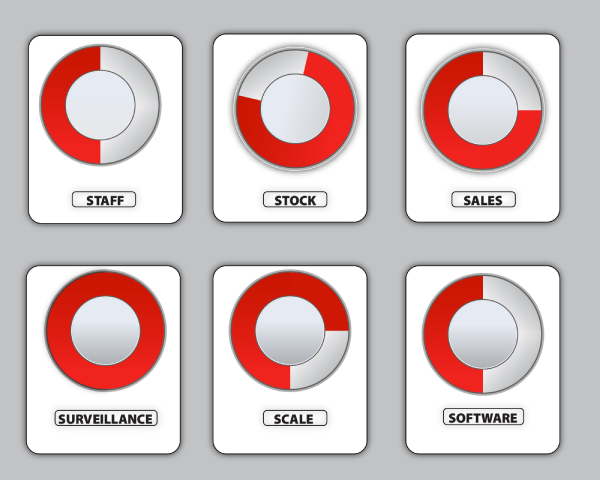
Retail Healthometer
Check the health of your business? Are you ready to organize & scale ?
Author Bio

Nikhil Agarwal
Chief Growth Officer


Get In Touch