
Importance of Consistency in Customer Experience in Retail
Imagine waking up every morning with your home environment slightly altered. From the first cup of caffeine to getting ready for work, you will have friction gliding with your routine. This is similar to what customers experience when they face even a slightly altered shopping environment. When the element of acquaintance with a brand is disturbed, it also upsets the passion and excitement they hold for the brand.
In this blog, YRC’s experienced team of retail CX consultants highlights proven principles and strategies for consistent customer experience in multi-store retailing.
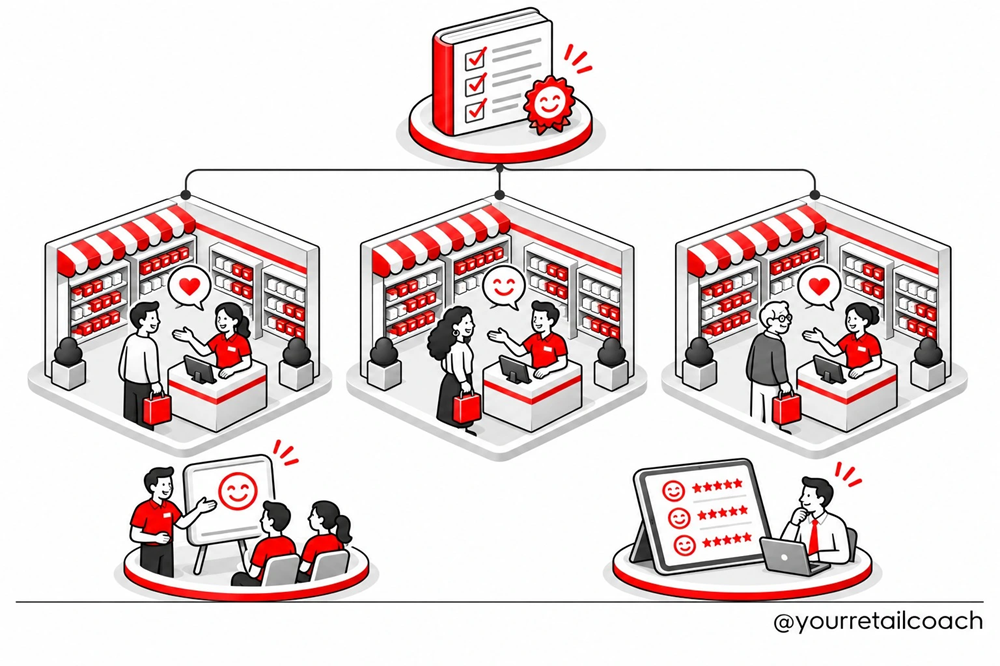
Maintaining Consistency in Customer Experience in Multi-Store Retail
Operations | Servicescape | Staffing | Tech Stack | Control System
Consistency in Operations (Operations Standardisation via SOP Implementation)
When you bring uniformity in operations or business processes, what you also effectively bring in is uniformity of operational outcomes. These operational outcomes affect customer experience in one way or the other.
Two best tactics for laying the foundation of robust operation standardisation are SOPs and technology. Here is a brief outline of standardising operations:
Carry out as-is process analysis – to get know-how of how your business model is being rolled out at the level of execution.
Map business processes and operations as they are required to be – This is necessary to ensure that your new process definitions best reflect the business requirements and do not fall back to the existing ineffective practices. However, it also does not imply that all existing processes and practices are below the required standards.
Develop and implement Standard Operating Procedures (SOPs) – These are your new process definitions that best reflect the alignment of process definitions with business requirements.
Integrate SOPs with IT systems – This warrants that the SOPs are not bypassed.
Make SOP adherence easier – for your employees. Stick to professional methods for SOP design and routine use. Keep the language short and simple. Use visual cues. Make use of SOP checklists. When SOPs are integrated with your IT systems, it becomes easier for your employees to follow the SOPs.
Provide SOP training – Train the trainers first.
Ensure strict compliance with SOPs – Enforce a system where SOPs are complied with as a part of organisational design and structure.
Link SOP compliance with Performance Management – for boosting a SOP culture.
Consistency in Servicescape (Infra & Layout, Sensory, Visuals)
Servicescape refers to the totality of the sensory, physical, and digital (non-human) environment in which the delivery of value(s) or value propositions takes place.
It is the place where purchase, consumption, and/or delivery of goods and services take place.
For a traditional store, its environment is its servicescape. The same of an online retailer is its frontend website or app. If it is the case of an omnichannel brand, servicescape encompasses all the online and physical touchpoints and channels.
Consistency in service is necessary to convey a unified brand message which in turn, helps that a brand is easily identified by customers without any doubt or confusion. Consistency in such kinds of brand messaging is necessary to ensure consistency in how customers experience a brand.
The three pillars of maintaining consistency in servicescape are:
Standardise Infrastructure and Layout Plans (Scalable)
- Store layout plans and infrastructural standards
- Aisle widths
- Queue length capacity
- Zone allocation (e.g. checkout counter, docking, kerbside pickup)
- Racking media
- Entry and exit ways
- Furniture and fixtures
Standardise Visual and Explicit Communication (e.g. signage, visual merchandising, etc.)
- Uniform price tagging, visuals and symbols, navigation marks and codes, display signs and fonts, promotional resources, notice boards, etc.
- Standardised visual merchandising and planogram
- Staff uniform
Set Measurable Standards for Sensory and Unspoken Elements
- Uniform air conditioning standards subject to localisation (e.g. temperature range)
- Uniform acoustics standards (e.g. music genre, tempo, BPM, outside noise cancellation)
- Uniform lighting standards (e.g. lux levels)
- Uniform painting standards
- Uniform scent/olfactory standards (e.g. fragrances to be used, use of diffusers)
Consistency in Hiring and Training (Professional HR)
After visuals, employees and their conduct are the first things to be noticed by customers. The human effect is much sturdier than any other element. This demands that you not only introduce high-quality staffing but also maintain dependability in their everyday conduct. And to accomplish this, you have to work on it from the early stages of planning and not after you have begun a store. Similar to how a business owner would bat an eye on income from each store, in the same fashion they must be as prudent about their human resource management.
Organisation Structure and Design
All the departments, teams, and employees must work in harmonisation for a business to operate as it should. A well-planned organisation structure and design supporting the business ensures that there is proper flow of communication, the workflow chains are seamless, authority-responsibility relationships are maintained, the chain of command is followed, and the span of control is maintained.
Centralised Hiring, Onboarding, Training, and PMS
You cannot afford to have different standards for hiring, onboarding, training, and PMS for different stores. As one establishment, you must have unvarying and integrated standards and processes for hiring, onboarding, training, and performance administration. This goes a long way in making things easier for business owners in delivering a cohesive custom experience unwaveringly across all locations. Different solutions that come into play here include:
- Standardised job descriptions (duties) and specifications (skills)
- Common screening process
- Online Onboarding and training kits
- Digital attendance and roster management
- Micro-learning tools
- Standardise KPIs and performance scorecards
- Common PMS and reward delivery system
- Feedback mechanism
One Tech Umbrella with Data Centralisation (One-Business-One-Tech Stack)
Think of a unified tech stack as a viewing and controlling source for all your surveillance cameras on one screen. It gives you a real-time view. It gives you an opportunity to take action if something is wrong. It lets you control your devices remotely from one place.
Now think in the context of retail. Cutting across channels and locations, you get a single source of truth for customer profiles, inventory, operations, performance, finance, marketing and promotions, logistics, staffing, and security and safety. There are no more data silos.
With the unified tech stack, you not only get a real-time view of the above, but can also exercise control over them. You can check and ensure that your pricing, promotional events, and other company policies are being uniformly followed and executed across locations. You can make necessary changes or introductions in the master database centrally from your head office.
Here is a brief outline for building a unified tech stack:
Make an assessment of your current technological ecosystem.
Identify what software applications are being used in your stores. Speak to store managers and employees, or collect feedback from them regarding the friction they experience in using these applications to comply with SOPs or business/process requirements.
Identify and establish the technological requirements for your business model and operations in terms of software, hardware, and networking capabilities. You have to also ensure that your functional tech systems talk to each other so that the entire tech stack works as one unified system.
Carry out a gap analysis to identify the right approach for implementing a unified tech ecosystem for your business.
Find the best-fit approach for your tech stack.
Two ideal options here are to either go for a new umbrella solution or a customised framework. The first option is relatively easier to implement. Go for the customised option if your business requirements are complex and standard customisation offered by popular software products won’t fit your business needs. You must bear in mind that linking legacy applications may not be a long-lasting solution and may warrant another tech upgrade in the near future.
The next step is to connect and sync all the functional applications (POS, OMS, HRM, etc.) to bring them under the chosen tech umbrella (ERP and Centralised Management System). This means that your software, hardware, and networking systems (from all distinct business functions) must stand integrated with your enterprise-wide business and operational requirements.
Other crucial activities include:
- SOP-IT integration
- Data migration
- RBAC (Role-Based Access Control)
- Incorporation of regulatory compliance
- Banking and payment infrastructure
- Integration of monitoring, audit, feedback, and reporting measures and mechanisms
- Before a full-scale launch, carry out pilot runs.
Bring a Robust Control Framework (Monitoring, Feedback Loop, Audit, Continuous Improvement)
After you have established the necessary mechanisms and systems in terms of people, process, technology, and servicescape, a crucial step that remains to be incorporated is monitoring and control. Your efforts will be wasted if you cannot ensure that the systems you have built for maintaining uniformity in CX are being properly followed. And to be able to do that, you must be able to keep an effective and efficient eye on your operations.
Here are some tools and tactics that make a robust monitoring and control framework for maintaining consistency in retail customer experience:
- SMART KPIs/standards of performance and results for monitoring and auditing purposes
- Executive dashboards (real-time monitoring)
- Mystery audits
- Periodic compliance audit – SOP, inventory, servicescape, staffing
- Customer reviews and feedback on the brand’s website and websites like Reddit and X (Twitter)
- Social listening and social monitoring
- Feedback system for employees and suppliers
- Localised authority for continuous improvement
Retail Healthometer
Check the health of your business? Are you ready to organize & scale ?
Author Bio

Nikhil Agarwal
Chief Growth Officer
Nikhil is a calm and composed individual who has a master’s degree in international business and finance from the United Kingdom. Nikhil Agarwal has worked with 300+ retail e-commerce brands and companies from various sectors, since 2012, to define their growth strategy and achieve operational excellence. Nikhil & his team have remarkable success stories of helping brands achieve 10X growth.