
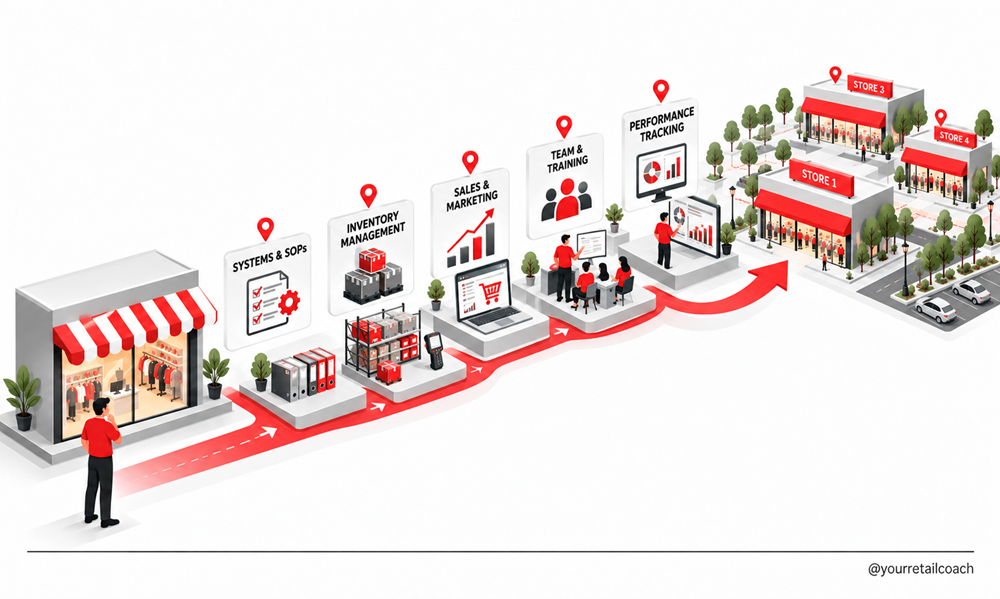
The secret to modern-day business expansion lies in planning and technology. While planning is all-encompassing in itself, technology needs a separate mention because of its far-reaching capabilities in both planning and action.
This blog highlights specific steps and focus areas quintessential for retail expansion in 2026.
Step 1 – Strengthen Your Retail Operations Framework by Implementing SOPs
Develop and Implement SOPs
You cannot think of scale and expansion in retail and eCommerce when your existing business system is not well-organised. It is easier to manage or expand an organised system. Unorganised business systems do not respond well to changes and directives, let alone speak of handling expansion.
The first step to become an organised retail business is to standardise operations. And to standardise operations, you must implement Standard Operating Procedures (SOPs). SOPs help businesses become process-oriented and disciplined.
Performance Monitoring and Audit Mechanism
How informed are you of the progress and developments happening in your business? How do you keep a tab on how things are going in your business? This is your internal awareness and intelligence about the state of your business. This is not micro-managing, but staying aware of business functioning on critical parameters.
Once you start adding stores, monitoring assumes greater significance because the cost of mistakes increases. So, you must establish a robust monitoring and audit system at the inception and then scale it later with confidence. Technology and automation have a big role to play here (discussed in step 3), but process orientation comes first (discussed in the above point on SOPs).
Step 2 – Strengthen Your Retail Business Organisation Structure with a Strong Mid-Level Management and Professional HR
Strong Middle-Level Management
Do you have the right management structures in place that would secure the success of your scaled business? In this context, you should specifically focus on building a strong mid-level management. Even if the team is small, there should be roles and positions between owners and line staff serving as a link. This makes organisation structures more agile and helps owners/founders focus on broader topics. You can build a strong middle-level management by creating managerial positions that would maintain the day-to-day affairs. Your interference in routine operations would be warranted only in exceptional circumstances under defined conditions of escalation.
Professionalism in HR
The quality of HR policies and systems has a direct bearing on the quality of your staffing. Every business needs quality people for both sustenance and expansion. To consistently secure this objective, every aspect of HR must be of superior quality (e.g. hiring, onboarding, pay, culture, change management). For example, even if you offer the best salaries, quality employees may still not be attracted if the work culture is poor. You must also have a clear vision of the workplace perception you want to set for your business.
Step 3 – Leverage Technology and Automation with Cloud POS, Automated Inventory Control, and Data Analytics
Do you have the right technology in place to run and manage a wide network of stores? Technology helps in nearly every area of running and managing the business. For example, if you want all stores to send daily reports to your office, technology will help you accomplish that easily. With automation, there may be even no need for manual intervention for sending those reports. With real-time updates from all POS systems across stores, all the sales and inventory data will be only a few clicks away.
Here are three crucial systems you must have if you are looking at an expanded network of stores:
Cloud POS Systems
With a web-based POS platform, you can have real-time access and control over any data handled by POS systems across your store network.
Cloud POS gives the advantage of real-time multi-store synchronisation. This means you can make changes in the central master catalogue from your head office. The benefits also extend to individual stores. Cross-store inventory lookup serves as an ideal example here.
Contemporary cloud-based POS applications also offer offline functioning and local sync. This addresses the concern of internet downtime. When internet connectivity is restored, applications can extract the offline transactions and sync them with servers.
Integrated omnichannel is another star feature of being on a cloud-based POS system. Your customers will have a seamless shopping experience irrespective of the sales channel or touchpoint they are interacting with.
Modern cloud-based POS solutions are not bound by device constraints. These applications can be accessed and used from any device with application support, network connectivity, and access rights. This means any sales employee present in a store can execute the checkout for customers. This also helps mitigate situations of longer checkout times during peak hours or festive seasons.
Automated Inventory Control
With one or two stores, it is easy for business owners to manually keep a tab on inventory. But with the addition of new stores, this task becomes progressively difficult. Hiring more employees is also not a viable solution. This is where technology (especially automation) kicks in. Here are some practical benefits of having automated inventory control:
- With Dynamic Reorder Points (ROP), you can maintain maximum product availability with optimised working capital.
- With automated allocation, the software can automatically route the right SKUs and quantities from the central warehouses or docking hub to the outlets that actually have the requirements.
- With inter-store transfer, you can always manage with the existing inventory pool instead of fresh procurements.
Data Analytics
Data analytics allow businesses to plan for and execute retail expansion in a scientific manner. It complements business acumen and the gravity of experience. Important applications of data analytics in retail scale and expansion cover:
- Site selection and target market identification and evaluation
- Assortment localisation and merchandising
- Dynamic inventory allocation
- Dynamic pricing, localised marketing
- KPI dashboards, multi-store performance monitoring, risk management
Step 4 – Get Meticulous with Your Finances
Financing retail expansion demands meticulous planning and execution. From assessing CapEx and OpEx requirements to keeping a tab on performance metrics, being realistic and precise with the numbers and the operational systems is crucial. Here are five areas to be taken seriously in retail expansion strategies concerning financial planning:
Capital Allocation and Store-Level Economics
One of the best approaches to deal with capital management in retail expansion is breaking down CapEx and OpEx for a single store unit model. Some of the considerations here are:
- Lease security, interiors and layout, visual merchandising, cloud/IT assets
- Inventory cost to merchandise all display and storage media at optimum
- Targeting 18-24 months as payback period for each store
- Targeting store-level EBITDA of 15%–22%
Store Unit Economics (Baseline Model)
|
Target Factor |
Target Goal as a Percentage of Net Sales
|
Strategic Significance
|
|
Gross Margin
|
30% to 50%+ (depending on category)
|
Creates room for net profit and overheads |
|
Cost of Occupancy
|
Less Than 7% to 12% |
Affects breakeven |
|
Staffing Expenses
|
8% to 15% |
Prioritise incentives based on store-level performance
|
|
Utility bills, local marketing efforts, tech expenses
|
3% to 6% |
Tech stack, localisation, essential services |
|
Store-Level EBITDA
|
18% to 22% |
Fund creation for growth |
Steps 5, 6 and 7 are covered in a concluding blog….
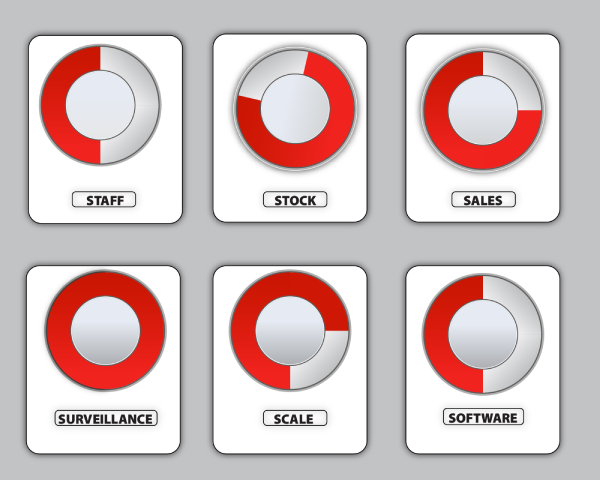
Retail Healthometer
Check the health of your business? Are you ready to organize & scale ?
Author Bio

Nikhil Agarwal
Chief Growth Officer
Nikhil is a calm and composed individual who has a master’s degree in international business and finance from the United Kingdom. Nikhil Agarwal has worked with 300+ retail e-commerce brands and companies from various sectors, since 2012, to define their growth strategy and achieve operational excellence. Nikhil & his team have remarkable success stories of helping brands achieve 10X growth.