

According to researchers, more than eight out of ten AI initiatives do not live up to the expected business results. They keep coming back to the same reason: the teams that launched new systems failed to understand the existing workflows. Likewise, the development of franchises is also in trouble.
A brand falls in love with the idea of scale, signs its first franchisee, then its fifth, and watches operations fracture across cities the founder has never visited. The difference between disciplined growth and an expensive mess almost always comes down to one thing: whether there was a real franchise development plan before the first agreement was signed.
This is the story of a brand that learned that lesson the hard way, and the franchise business plan that pulled it back from the brink.
The Brand That Grew Faster Than It Could Manage
Meet Meera, founder of a mid-sized home décor label with eleven company-owned stores and a growing waitlist of investors asking to open outlets under her name. She said yes to three of them within four months. No manual, no financial model, no shared playbook ; just her floor managers fielding panicked calls from franchisees who didn’t know how to place a repeat order or handle a warranty claim.
Within a year, two of the three franchise stores were losing money, and the third was thriving only because its owner had, coincidentally, run a retail business before. Meera had treated franchising as a licensing deal rather than a discipline. She had no franchise development plan, no documented franchise model development process, and no way to tell a good franchise applicant from a risky one.
- Franchisees received verbal instructions instead of written SOPs
- Pricing and promotions were inconsistent from store to store
- There was no financial model separating franchisor revenue from franchisee returns
- Legal terms lived in email threads, not in a signed agreement
Sound familiar? It’s the retail equivalent of deploying a shiny new system on top of chaotic, undocumented processes ; and expecting it to somehow behave.
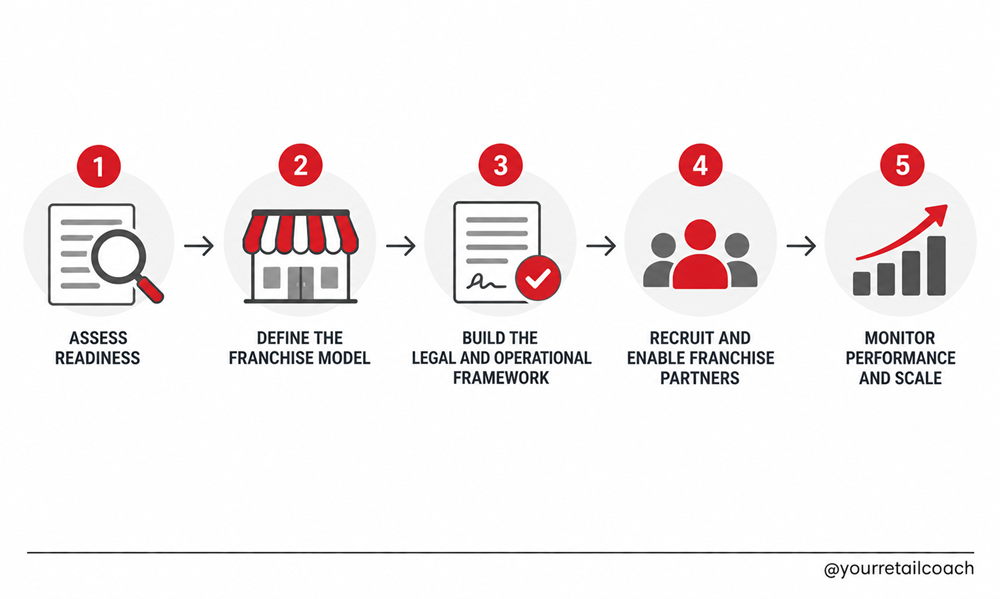
Step 1: Assess Feasibility Before You Franchise Your Business
Meera’s first real conversation with a franchise consulting services provider didn’t start with paperwork. It started with a hard question: is this brand actually ready to franchise?
A credible franchise development plan always opens with a feasibility assessment ; an honest look at whether the brand’s margins, systems, and brand equity can survive being run by someone else. This stage typically covers:
- Unit economics: can a franchisee realistically break even and profit?
- Brand differentiation: is there a genuine reason customers would pay for this over a competitor?
- Operational readiness: are processes documented well enough to be taught?
- Geographic and category runway: how much real expansion room exists?
For Meera, the honest answer was bruising. Her stores worked because she personally caught problems before customers noticed. That knowledge lived in her head, not in any process a franchisee could follow. Franchise development, done properly, starts by naming that gap out loud instead of expanding past it.
Step 2: Choose the Right Franchise Model Development Path
Not every franchise model fits every brand, and this is where many owners guess instead of analysing. Franchise model development means deciding, deliberately, who invests and who operates:
- FOFO (Franchise Owned, Franchise Operated): the franchisee invests and runs the store ; common for brands without the bandwidth to operate every outlet themselves.
- FOCO (Franchise Owned, Company Operated): the franchisee funds the store, but the franchisor runs it ; familiar from large QSR chains.
- COCO (Company Owned, Company Operated): used selectively, often for flagship or training locations.
- Hybrid models: blended structures suited to brands expanding across very different markets.
Meera had unknowingly picked FOFO for a business that needed the tighter oversight of a FOCO structure. Getting this decision wrong early is expensive to reverse later, which is exactly why franchise model development belongs at the front of the process, not somewhere in the fine print of a contract.
Step 3: Build the Financial Backbone ; Your Franchise Business Plan
A franchise business plan is not a pitch deck. It’s two linked financial models ; one for the franchisor, one for the franchisee ; that both have to work at the same time. If only the franchisor profits, franchisees churn out within a year. If only the franchisee profits, the brand can’t sustain support and quality control.
A working franchise business plan typically includes:
- A five-year sales and operations projection
- Franchisee CAPEX and OPEX, with a realistic breakeven timeline
- Franchisor revenue streams: royalties, franchise fees, supply margins
- Return on investment and return on capital for both parties
- An exit clause spelling out what happens if either side wants out
When Meera finally saw her numbers laid out this way, the problem was obvious: her franchise fee barely covered onboarding costs, and her royalty structure left franchisees too thin to reinvest in their stores. No wonder two of three were struggling.
Step 4: Turn Tacit Knowledge Into a Franchise Operations Manual
This is the step Meera had skipped entirely, and it’s usually the one that decides whether a franchise development plan survives contact with reality. Every process that lived in Meera’s head had to become a document a stranger could follow on day one.. How to greet a difficult customer, when to escalate a warranty claim, how to reorder fast-moving SKUs.
- Define each task by who, what, when, where, and how
- Separate routine operations from high-risk, high-value exceptions
- Use plain, affirmative language and simple decision points
- Build both printed and digital versions, and pilot-test them in one store before rolling out everywhere
Franchise consulting services earn their keep here more than almost anywhere else, because an outsider can spot the unspoken assumptions a founder no longer even notices.
Step 5: Lock Down the Legal Framework
A franchise agreement is a place where intentions meet viability. It has to safeguard the integrity of the brand and provide the franchisee with fair and clear terms of franchise covering territory rights, supply obligations, quality standards, conditions for renewal, and what happens if there is a bad ending to the relationship.
Meera’s original “agreements” were little more than friendly emails. Once real terms were drafted, disclosure documents, a proper franchise agreement, and an exit clause; both sides finally knew exactly where they stood. A franchise development plan without airtight legal documentation is a plan with a hole in its foundation.
Step 6: Build a Lead Generation Engine, Not a Wish List
The final piece of franchise development is finding the right franchisees, not just any franchisee with capital. Meera’s earlier expansion had been reactive: she said yes to whoever asked first. A structured approach looks different:
- A data-backed franchise pitch deck that shows real unit economics, not just brand excitement
- A defined ideal-franchisee profile, screened against operational and financial fit
- Digital channels built specifically to generate qualified enquiries, not just volume
- A “golden five” mindset ; treating the first handful of franchisees as the proof point every future applicant will judge the brand by
Eighteen months after her first honest feasibility assessment, Meera’s brand had a documented franchise development plan, a rebalanced franchise business plan, and four new franchise stores that were profitable from month one.
Why YRC
Your Retail Coach built its reputation on exactly the gap Meera fell into: the space between an ambitious idea and an operational reality that can support it. YRC’s franchise consulting services bring together financial, legal, process, and marketing specialists who work as one team rather than handing a brand between departments.
What sets YRC apart is a genuinely custom-built franchise development plan for every client ; never a template ; paired with SOPs built for that brand’s specific operations. Clutch has recognised YRC among the top franchise consulting firms globally, based on verified client experience rather than self-reported claims.
About YRC
Your Retail Coach (YRC) is a retail and business consulting firm that has guided brands across more than 25 industries through franchise development, standard operating procedures, and business expansion strategy across Asia, the Middle East, Africa, and beyond.
- Over a decade of hands-on franchise consulting services experience
- End-to-end support: feasibility, franchise model development, financial planning, legal documentation, and lead generation
- A cross-functional team of financial, legal, process, and marketing experts
- A track record recognised by verifiable client case studies
Retail Healthometer
Check the health of your business? Are you ready to organize & scale ?
Author Bio

Nikhil Agarwal
Chief Growth Officer
Nikhil is a calm and composed individual who has a master’s degree in international business and finance from the United Kingdom. Nikhil Agarwal has worked with 300+ retail e-commerce brands and companies from various sectors, since 2012, to define their growth strategy and achieve operational excellence. Nikhil & his team have remarkable success stories of helping brands achieve 10X growth.