
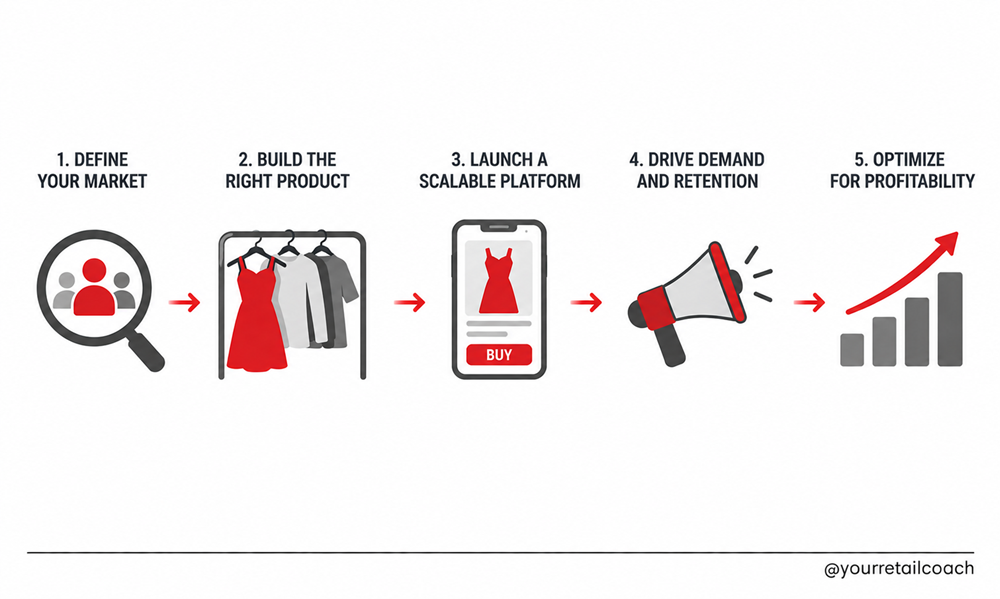
Recent global industry metrics reveal that over 70% of enterprise AI implementations fail to meet projected performance targets not because the underlying artificial intelligence algorithms are defective, but because organizations deploy automated tools onto fundamentally flawed, unstandardized operational workflows. In the hyper-competitive e-commerce marketplace of 2026, attempting to fix underlying operational friction with raw technological speed only accelerates chaotic inventory management mistakes and burns through investment capital.
To build a profitable fashion e-commerce enterprise today, fashion brands must move beyond industry hype. True financial sustainability requires establishing process maturity, mastering inventory budgeting, executing precise fulfillment routines, and ensuring seamless handshaking between physical operating procedures and enterprise software systems.
The Illusion of Algorithmic Quick Fixes
This is the case of an emerging fashion brand that wished to mitigate high customer acquisition expenses and lower gross margins through heavy investment in machine learning technologies. The management decided to tackle the concerns regarding the stockouts of inventory and the growth in the markdowns by way of implementing an automated forecasting platform.
Soon enough, one can see the high inventory costs, the doubling of errors in order fulfillment, and record quantities of returned goods.
The establishment of a successful fashion e-commerce enterprise in 2026 requires knowing that technology is simply an amplifier of operational maturity. If baseline processes have concealed bottlenecks technology will simply augment their inefficiency.
How to Establish Process Maturity Across Your Enterprise
Before obtaining cutting-edge software and committing to full implementation of AI technology, fashion companies should create stable processes within four key pillars of their business: People, Process, Technology and Infrastructure.
In order to achieve sustainable scale, companies must implement a clear step-by-step operational plan.
- Step 1: Getting Started with As-Is Workflow Mapping – Work on documenting each point of engagement within the supply chain. This process must start from the issuance of the purchase order and supplier dispatch, extending through warehouse dock receiving, stowage, picking, packing, shipment, and reverse logistics activities.
- Step 2: Knowing the Basics of the Creation of SOPs – You should create unambiguous and precise SOPs that describe each procedure step adopted by various functional departments, decision points, escalation paths, and the procedures followed in case of exceptions.
- Step 3: Having Well-defined Job Descriptions and KRAs – It is necessary to create Job Descriptions and Key Responsibility Areas for each position in the organization, ensuring accountability and the need for SOP compliance.
- Step 4: Knowing SOP Pilot Testing – Run controlled pilot tests of newly designed workflows in designated operational zones to measure throughput, gather observer feedback, and fix process gaps prior to full enterprise deployment.
Through comprehensive process mapping and standardisation, fashion e-commerce companies eliminate functional silos and ensure enterprise-wide operational handshaking before scaling operations.
How to Implement Open-To-Buy (OTB) for Balanced Inventory Control
In the fashion industry, cash tie-ups and margin losses occur fundamentally as a result of expected inventory management errors. Having too much stock results in substantial markdowns, while a lack of products leads to loss of sales and dissatisfaction of customers.
To create a sustainable online fashion business in 2026, the managers of a retail company will have to apply an Open-To-Buy (OTB) methodology in order to have correct inventory balance.
The Step-by-Step OTB Process
- Step 1: Calculate Sales Projections – Analyze historical sales data, market demand trends, and promotional goals to forecast monthly revenue and unit velocity.
- Step 2: How to Map Intended Markdowns – Calculate planned promotional spend, markdown dollars, and seasonal discount allowances for the target period.
- Step 3: How to Determine Required Closing Stock (EOM) – Calculate the required End-of-Month (EOM) inventory target by multiplying projected monthly sales by the industry-standard sales-to-stock ratio.
- Step 4: How to Calculate Total Stock Available – Sum the opening inventory balance at Beginning-of-Month (BOM) with incoming on-order stock scheduled for delivery.
- Step 5: How to Determine Total Stock Needed – Add projected sales, planned markdowns, and target EOM closing stock to derive total required stock value.
- Step 6: How to Calculate Net OTB Budget – Subtract total available stock from total required stock to calculate net purchasing capacity at retail price, then multiply by the cost factor (1 – Markup %) to establish the wholesale purchasing budget.
Managing OTB across thousands of individual SKUs requires embedding these mathematical rules directly into your demand planning systems and ERP environment.
How to Optimize Warehouse Layout and Fulfillment Operations
A fashion e-commerce enterprise cannot maintain profitability if fulfillment center operations suffer from dock congestion, picking errors, or slow reverse logistics turnaround times.
Optimizing fulfillment centers requires combining structured spatial layout planning with precise system integration:
- Step 1: How to Undertake Warehouse Zoning and Layout Planning – Create logical paths of work that will include U-shaped or I-shaped inventory flows. This will ensure independent sections of the warehouse, such as receiving docks, storage racks, picking areas, packing stations, and return areas.
- Step 2: How to Reinforce the Integration of IT and SOP – Set up warehouse IT systems (WMS and ERP) so that compliance with the processes is ensured. For instance, implement e-GRN at receiving docks so that unverified goods cannot penetrate stock records.
- Step 3: How to Standardize Reverse Logistics Processes – Implement rigorous procedures in handling returns that will explain the inspections of returned items, requirements for re-tagging, steam-pressing processes, as well as automating the storage of the sellable products.
- Step 4: Conducting SOP Compliance and Performance Audits – Carry out weekly self-audits, monthly peer reviews, and quarterly company audits using score-keeping methods to track accuracy during order picking and ensure that no loss of stock happens.
Establishing standardized warehouse processes prevents inventory shrinkage, improves order turnaround time, and protects profit margins as order volumes expand.
How to Standardize Omnichannel and Franchise Expansion
As online fashion brands venture into physical locations such as pop-up stores and franchise systems, brand consistency and operational efficiency become vital when handling multiple locations.
For e-commerce and retail business growth, they must have a consistent operational model throughout all channels of sales:
- Stage 1: Connecting Core Technology Stack Systems = Integrate in real-time Point of Sale (POS) systems with the online store as well as the centralized enterprise resource planning (ERP) systems in order to have consolidated information about inventory.
- Stage 2: Implementation of Digital Learning and Task Management Systems – Deploy Onboarding and Learning Management Systems (OLMS) together with Digital Task Management tools for compliance by field staff and store managers in terms of visual merchandising, planogram designing, and customer service.
- Stage 3: Deploying Automated Inventory Replenishment – Set up automated inventory replenishment systems utilizing the real-time sales velocity, vendor lead times, and open-to-buy budget to maintain inventory management automatically.
- Stage 4: Implementation of AI-Driven Operational Analytics – Set up centralized analytic dashboards with embedded AI technology to evaluate scorecards of compliance in the store, success of the visual merchandising strategy, and efficiency of conversion rate across all business units.
Why YRC?
YRC has been a frontrunner in the retail and e-commerce consulting industry for over a decade. YRC specializes in linking the high-level strategy to ground-level execution.
YRC has accomplished this by spotting operational impediments and establishing the workflows. We have also put together customized SOPs and brought the organizational structure in line, along with monitoring IT integration to achieve operational efficiency.
About YRC
Your Retail Coach (YRC) is a consulting company operating in the field of management consulting, specializing in retail operations, e-commerce transformation, and the engineering of supply chain. The company helps fashion, apparel, and consumer brands develop efficient, scalable, and process-focused business models.
- Core consulting capabilities: Standard operating procedure development, process mapping, existing version/end version blueprinting and integration of SOP into IT.
- Key operational areas: Open to buy implementation, inventory optimization, warehouse planning, omnichannel approach.
- Some of their industries of specialization include apparel, luxury & jewelry, shoes, sportswear, and multi-brand retail.
- Worldwide activity: the company has executed over 500 successful consulting contracts in over 25 retail verticals.
FAQs
What are the reasons for the shrinking profit margins in fashion e-commerce businesses?
Fashion e-commerce companies are known to give prominence to sales instead of operating efficiency. As a result, margins experience deterioration due to high product returns, stock shortages, budget-free markdowns, and losses due to theft as well as non-standardized workflows in the warehouse.
How to use Open-To-Buy (OTB) to improve cash flow?
Calculate OTB by subtracting existing and on-order stock from total needed stock (sales forecast + markdowns + closing inventory target). This ensures purchasing stays within budget and prevents capital lockup in excess inventory.
How to ensure successful SOP-IT integration in e-commerce?
Enforce strict system validation protocols where software actions require physical compliance. For example, configure the WMS so inventory cannot be marked as available stock until an e-GRN dock scan is successfully completed.
How to optimize reverse logistics for fashion apparel?
Establish standardized returns SOPs that detail immediate inspection, grading, steam-pressing, and automated re-tagging protocols. This allows returned items to return to available online stock within 24-48 hours.
How long does SOP development take?
Comprehensive mapping, drafting, pilot testing, and team training for SOPs normally last between 8 and 16 weeks. In this period, several things matter, such as the company size, operational complexity, and the number of departments for which SOPs are developed.
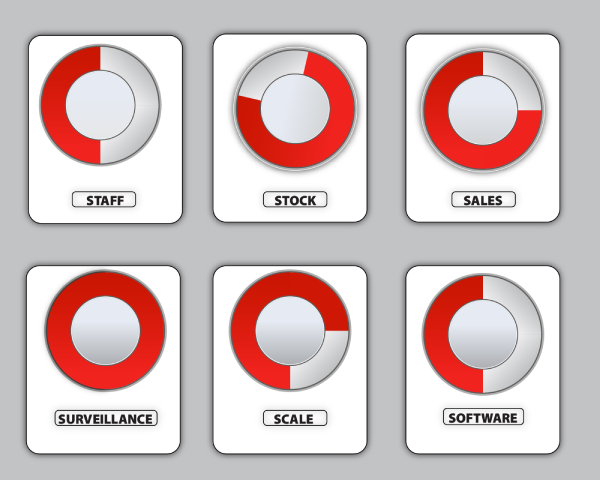
Retail Healthometer
Check the health of your business? Are you ready to organize & scale ?
Author Bio

Nikhil Agarwal
Chief Growth Officer