
E-Commerce is affected worldwide by the transition to circular economy practices. Due to increasing concerns over environmental issues such as waste, CO2 emissions and resource scarcity, e-retailers need to reconsider the sourcing, packaging, distribution, collection and re-use of their products. The traditional business model of create, sell and discard does not meet either environmental obligations or regulatory requirements; therefore brands are adopting more holistic approaches where the materials can be cycled repeatedly, thus lowering both the operating costs of the business and its environmental footprint.
In order to implement these extensive changes, there needs to be a complete understanding of how e-commerce digital processes are interconnected throughout their respective value chains.
Companies wishing to build circularity into their operations must thoroughly map out the life cycles of their products, identify process inefficiencies, re-design processes to eliminate waste, etc. The use of Signavio’s BPM solution for e-commerce will help to facilitate this shift, as it provides retailers with the means of obtaining a well-organised view of their organisational processes now, and how they should look going forward. Mapping of the e-retail process can expose areas of business operations that suffer from excessive packaging, high levels of returns, wastage through inefficient reverse logistics or lost potential through missed repair opportunities. When combined with financial models and environmental sustainability performance indicators, Signavio will enable organisations to develop their decision-making processes toward activities that are not only environmentally responsible, but also economically feasible. Thus, the circular economy will not only serve as a current buzzword; it will quickly become an integral element to establishing and sustaining a competitive edge in the e-commerce sector.
How Signavio Reveals Waste Across the Retail Value Chain
Tools for e-commerce, like Signavio, use process mining to find bottlenecks that lead to wasted resources, such as excess packaging, redundant transportation routes and inefficient warehouse configurations.
When Signavio analyses real-time operational data within e-commerce operations, it identifies areas where costs and emissions peak, from order processing through to last-mile delivery.
The ability to measure the effectiveness of online retail process optimization is facilitated by Signavio’s ability to identify deviations in processes; with this information, companies can establish standardised eco-efficient practices.
Businesses may visualise the online retail customer journey through the mapping of their customers’ lifecycle; in doing so, they can identify places where the returns process generates avoidable carbon emissions or where the opportunity exists to introduce a reusable packaging programme into their overall retail strategy.
Using Signavio BPM for e-commerce, for example, scenario modelling allows teams to create forecasts of both the environmental and cost implications of circular strategies (repair versus refill).
Cross-functional collaboration across multiple teams is enhanced as Signavio helps create a commonality of language regarding sustainability and facilitates alignment amongst IT, Logistics, Customer Service and Supply Chain on common green objectives.
Good digital commerce process excellence ensures that sustainability is a fully integrated initiative, embedded across the entire operational ecosystem, not maintained as a siloed strategy.
With transparency into data, retailers reduce waste every step along the way as they move from a linear to a circular supply chain.
Closed-Loop Logistics in E-Commerce
For robust closed-loop logistics systems to operate effectively, a very well thought out circular economy must be developed. For e-commerce companies, the development of such systems will require the redesign of the product, the packaging and all other materials to allow these items to continuously circulate between customers and businesses instead of being thrown away and going to landfill.
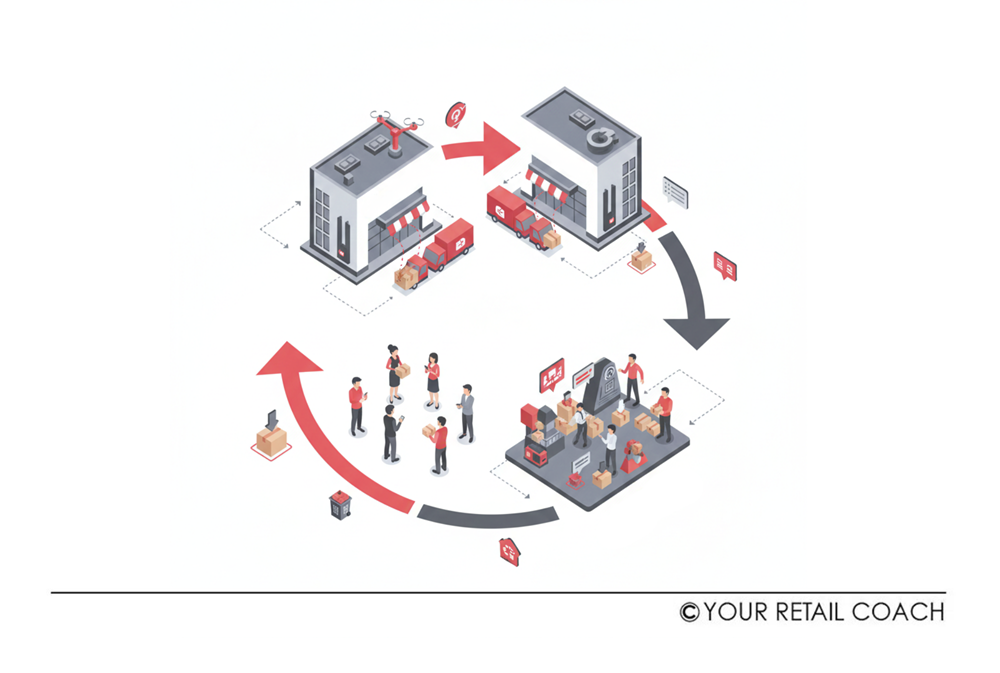
In order to develop such a closed-loop system, e-commerce companies must coordinate their shipping partners, warehouse facilities, return centres and recyclers seamlessly with each other. A solution such as Signavio BPM for e-commerce enables e-commerce companies to model the end-to-end flows of their items, providing clear visibility of how their items are being circulated through multiple life cycles.
By conducting process mining on their e-commerce processes, retailers can uncover process delays and inefficiencies in the reverse logistics process. The reverse logistics process represents one of the highest sources of carbon emissions related to e-commerce. Therefore, by identifying the sources of where items get stuck, where return costs become excessive and where eco-friendly refurbishment is not performed, e-commerce companies can optimize their processes to mitigate both their environmental impact and their spend.
Process optimisation allows e-commerce retailers to look at various reusable packaging loops, centralised sorting centres and environmentally-friendly routing algorithms. Mapping the customer journey for e-commerce retailers helps them identify areas of friction that exist when customers are going to return, exchange or repair an item. Therefore, e-commerce retailers should strive to ensure the customer journey remains frictionless to promote sustainable behaviours. Through excellence in digital commerce processes, e-commerce retailers will be able to develop logistics systems that will allow every component of the logistics system to flow back into productive use.
How Signavio Enables Efficient Reverse Logistics & Repair Programs
With its e-commerce-focused Signavio BPM, companies have access to preconfigured Modeling Frameworks that illustrate the reverse logistics for e-commerce transactions, detailing how Returns flow, Repair Pathways and Refurbishment Cycles work within those processes.
- Process Mining technologies help online retailers identify inefficiencies such as multiple-transit hops and unnecessary inspections that increase their carbon footprint.
- Retail Process Optimization allows retailers to quickly identify items suitable for Repair or Resale, reducing the risk of wasteful disposal.
- Journey Maps for online retail highlight customer-facing activities related to Returns to simplify the process for customers while encouraging sustainable alternatives (repair/exchange).
- Digital Commerce Process Excellence provides retailers with an opportunity to leverage Automation in returns processing, such as automatically routing returned products to nearby Refurbishment Centers and instantaneously generating repair tickets.
- With the use of Signavio, retailers can compare the impacts of various circular strategies (Repair, Resale, Part Harvesting and Recycling) against each other.
- Retailers are able to Simulate Costs, Turnaround Times and Sustainability Enhancements of large-scale repair programs before implementing them on a larger scale.
By improving communication and increasing automation capabilities between reverse logistics and front-end operations, retailers improve the efficiency of both operations and create value rather than a cost-center due to Reverse Logistics.
About YRC
YRC Consulting provides specialized consulting services in e-commerce, focusing on helping businesses improve their online sales and optimize the processes involved in selling online. YRC has extensive experience with Signavio’s BPM methodology in e-commerce, allowing YRC to assist companies in identifying their current processes for e-commerce and how to improve them through better design.
In addition, YRC has a strong focus on using data to identify and fix problems with fulfillment, inventory and last mile delivery through process mining techniques. YRC then leverages this information to develop solutions to improve these areas of the business.
Through the use of mapping online retail customers’ journey through the purchase and post purchase experience, YRC helps businesses improve their customers’ experiences while at the same time streamlining the backend processes.
Retail Healthometer
Check the health of your business? Are you ready to organize & scale ?
Author Bio

Nikhil Agarwal
Chief Growth Officer
Nikhil is a calm and composed individual who has a master’s degree in international business and finance from the United Kingdom. Nikhil Agarwal has worked with 300+ retail e-commerce brands and companies from various sectors, since 2012, to define their growth strategy and achieve operational excellence. Nikhil & his team have remarkable success stories of helping brands achieve 10X growth.