
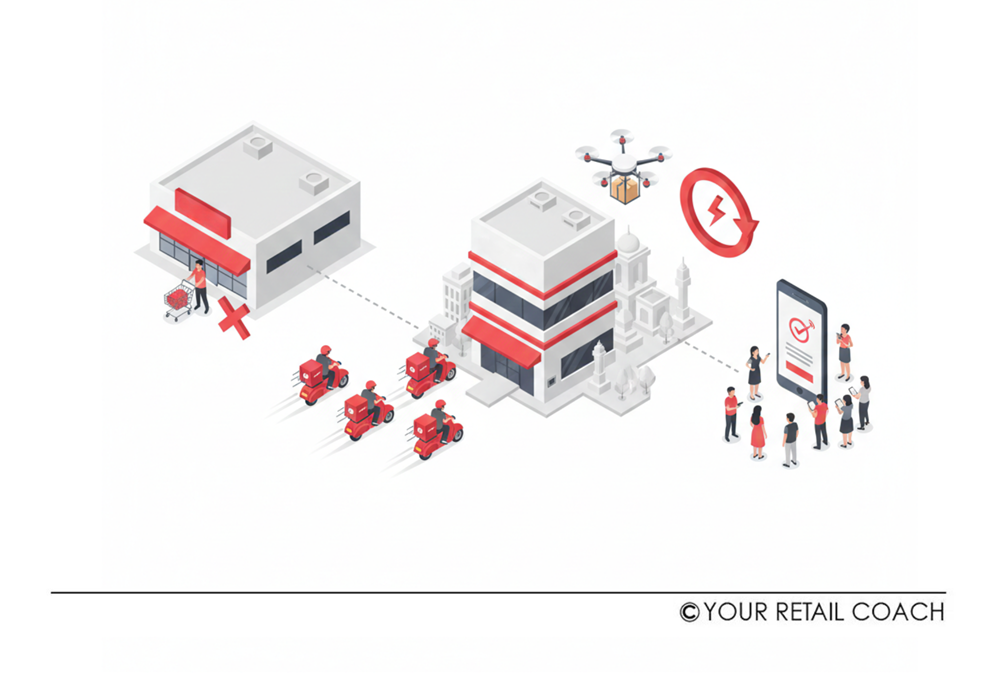
Over the past couple of years, q-commerce has turned into one of the most important, if not challenging parts of India’s urban retail landscape. The initial focus on how to grow convenience within this space has shifted to growing q-commerce as a common way for consumers to spend money across the largest metropolitan cities such as Mumbai, Delhi NCR, Bengaluru, Chennai, and Hyderabad. The idea behind q-commerce is relatively simple: that people can get groceries and other everyday goods delivered to their doorstep within minutes after placing their order.
The way that this speed has changed the way urban consumers purchase and manage their households, including planning and planning their weekly grocery list, and ultimately replenishing and maintaining their household, is fundamental. People no longer have to wait for their grocery lists to arrive in the mail, nor do they need to search for specific items when visiting stores. Instead, they simply buy their items when they need them. The development and implementation of q-commerce are made possible through a complex web of micro-locations, demand forecasting systems, local logistic networks, and computerized inventory algorithms.
The adoption of q-commerce will impact all aspects of urban retail planning across cities, changing the retail supply chain, how local governments segment urban/urban versus urban consumer segments, and how consumers make purchasing decisions. This article will explore the changes resulting from the introduction and growth of q-commerce.
How Q-Commerce Is Rewiring Urban Grocery Delivery in India
The urban population of India creates a scenario in which each of these factors is present simultaneously: an extremely high density of population density (people living in small areas, an increasing use of smartphone-type devices, digital literacy among consumers, and more than enough demand for quicker and easier purchasing options.
Additionally, for the most part, a micro-fulfillment point (where consumers order their items) is located within a few kilometers of their home. QT can deliver products directly to the consumer’s home, allowing a delivery fleet to fulfill orders in a matter of minutes. Also, the time saved by busy professionals, college students, and nuclear families is a factor in choosing on-demand purchases as opposed to traditional weekly grocery shopping trips.
The Invisible Infrastructure Behind the Speed of the Dark Stores
Dark Stores, the essence of q-commerce, are mini warehouses that have been purposely built to serve as fulfillment centers for only online orders. They differ from conventional retail stores because they focus on fast, efficient and highly accurate order fulfillment rather than merchandising and displaying products for walk-in customers.
Dark Store Layouts are designed to provide a fast and effective environment in which to quickly pick and pack orders for shipment to customers. This means that high-velocity SKUs (Stock Keeping Units) are stored in close proximity to the order dispatch zone, while high-velocity SKUs are stored at the back of the store. Because of the increased demand for rapid delivery services, Dark Stores have linear replenishment cycles, which means that there are multiple replenishment cycles daily.
Benefits of Dark Stores:
- Fast pick and pack times enabled by optimized layouts
- Improved order accuracy enabled by real-time tracking of inventory
- Decreased delivery distance resulting in more efficient and predictable service
Consumer Behaviour Shifting From Stocking Up to Topping Up
The largest change in consumer behavior caused by q-commerce is how we now view grocery shopping as a whole. grocery shopping used to be a weekly planning event, but now families operate on a buy on demand basis. On average, families will buy fresh fruits and vegetables, breads, milk, cooking ingredients, and snacks throughout the week in 10-15 different purchases instead of on this weekly basis. This new mode of grocery shopping will have a dramatic impact by alleviating the pressure of planning a pantry while at the same time increasing the number of micro-purchases.
Another change in consumer behavior caused by q-commerce is the increased willingness of consumers to experiment with products. Consumers have greater access to smaller package sizes and faster delivery of specialty items than ever before, giving them a higher probability of experimenting with new categories on more frequent occasions. The ease and simplicity of this process (order-pay-receive) will erase the friction of e-commerce and will in turn create a convenience expectation instead of a premium.
How Logistics Evolved to Make Minutes-Delivery Possible
Grocery delivery in minutes is more than just having fast riders. Successful grocery delivery service requires an integrated ecosystem of technology and operational strength that serves the local market. Route optimization algorithms match the closest rider with the nearest dark store. Predictive demand forecasting will ensure that popular SKUs never become out of stock. Local logistics teams have the ability to monitor traffic and peak hour patterns. Increasingly, fleets are moving to electrification of two-wheelers to lower costs and improve service levels.
The Q-commerce has developed new technologies for grocery fulfillment such as batch-picking (picking multiple orders in one picking run), smart shelving (shelving that has the capability to hold multiple SKUs), automatic stock reconciliation, and refrigerated storage for perishables. All these technological advancements reduce the incidence of errors, maintain the quality of products, and keep fulfillment times down even during peak hours.
The Rise of High-Velocity Urban SKUs
Grocery delivery is not designed to replicate the full product offering of a grocery store and it shouldn’t. The successful q-commerce delivery model is centred around the need for urgent purchases and products that require spontaneous buying decisions. Common metropolitan q-commerce product offerings include:
- Fresh fruits and vegetables
- Fresh dairy products
- Fresh bakery items
- Healthy Snacks and Drinks
- Ready-to-eat food products
- Personal care and Hygiene Products
- Starter grocery items
- Emergency Essentials like batteries, medicines that are allowed under regulatory guidelines and feminine products.
The limited but deep product offerings of q-commerce help to facilitate quick and efficient picking, as well as help eliminate overstock. Over time, q-commerce is developing new consumer behaviours; as more consumers are learning to expect to purchase products that come in smaller pack sizes, and are also creating a greater need for quicker re-ordering, manufacturers will continue to create and sell more and more exclusive SKU’s for the express purpose of being delivered quickly.
Impact on Traditional Retail
Now that grocery shopping has become more complex than ever before, we find the supermarket vs. small neighborhood store rivalry playing out in very different ways than the past. There continue to be concerns about q-commerce eating into offline grocery sales, but the evolution of this marketplace will continue to reveal itself.
In response, traditional retail continues to adapt:
- Establishing stronger home-delivery networks
- Collaborating with digital platforms to provide enhanced online presence
- Creating greater numbers of ready-for-pickup (R4P) counters for popular/fast-selling products
- Creating tighter and more efficient supply chains to eliminate out-of-stocks
While there are still traditional retail-only competitors, many are beginning to combine their existing inventory with instant delivery through hybrid models, effectively combining the advantages of having a physical storefront with having instant digital fulfillment capabilities.
Economics of Speed
Capital intensity characterizes the q-commerce model. Dark stores, fulfillment centers that support same-day delivery, necessitate a great deal of upfront investment; however, once operational, the way in which inventory is synchronized, the need for riders to have a sufficient number of orders per day to remain productive, and how to optimize the delivery fleet to reduce per-order costs are critical factors in creating a profitable q-commerce operation. Therefore, increasing order density for each dark store within every delivery zone must occur in order to ultimately lead to a decline in the cost per delivery, thus allowing for sustainability.
In addition to increasing density, certain additional revenue sources can be leveraged to improve profitability, including:
- Private label SKUs with larger profit margins
- Delivery subscription program
- In-app advertising by brands
- Optimized assortment to reduce waste
- Improvements in inventory turnover
FAQs
How should brands prepare their Supply Chains for Quick Commerce integrations?
Does a business need a dark store to operate in quick commerce?
What type of Assortment works best in a q-commerce model?
Author Bio

Rupal Agarwal
Chief Strategy Officer


Get In Touch