

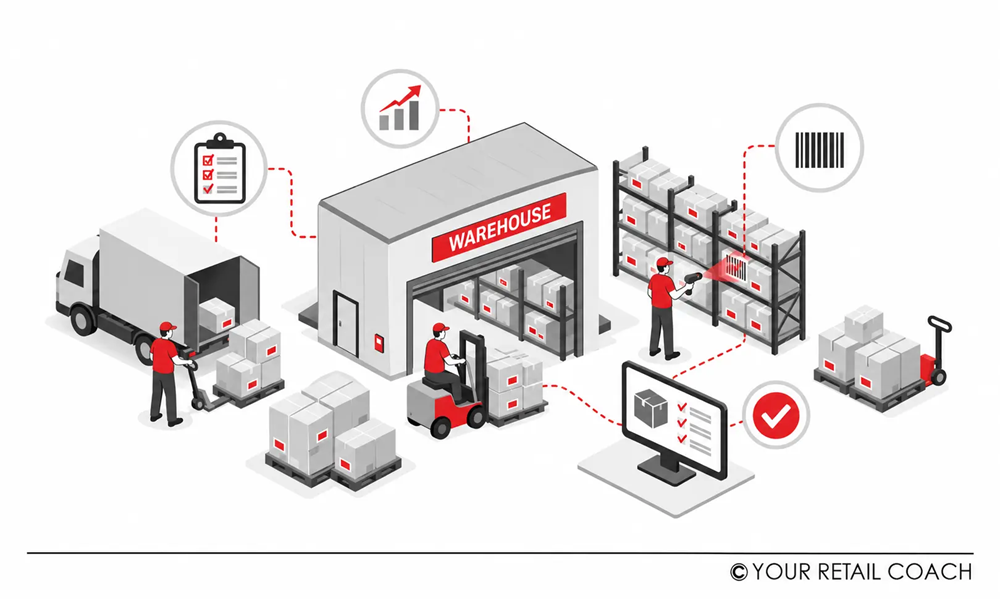
Inventory inaccuracies weaken replenishment planning, increase stock-outs, and inflate carrying costs. Many retailers still depend on fragmented warehouse tracking methods, delayed stock updates, and manual reconciliation processes. As inventory moves between stores, warehouses, and fulfillment points, visibility gaps increase operational risk.
The solution is centralized inventory control supported by a retail wms. Retailers need to have their receiving, storage, dispatch and stock verification processes working together smoothly. This is done through a warehouse management system for retail. When retailers track their inventory accurately the leadership teams of retailers can make decisions about replenishing the stock of retailers. This also helps retailers reduce mistakes with their stock and make sure that retailers can fulfill orders reliably. The inventory tracking of retailers is very important for the success of retail business.
A structured retail store warehouse operation supported by real-time inventory visibility improves stock confidence levels across the network. Retailers also gain stronger allocation control when warehouse operations are integrated with a multi store inventory management system. A connected stores supply warehouse structure enables consistent inventory reporting across regions and formats.
How to Improve Inventory Accuracy Through Warehouse Receiving Controls
Inventory accuracy begins at the receiving dock. Errors during inbound processing create downstream discrepancies across replenishment, dispatch, and store allocation.
Standardize Receiving Verification
Every retail store warehouse should implement mandatory inbound validation processes covering barcode verification, quantity matching, supplier reconciliation, and damage inspection.
Recommended Controls
- Barcode scanning during receipt confirmation
- ASN validation before inventory acceptance
- Automated discrepancy reporting
- Dock-level quantity checks
- Segregation of damaged inventory
A disciplined stores supply warehouse operation minimizes inventory variances from the first touchpoint. Retailers using a warehouse management system for retail can also monitor supplier compliance and receiving turnaround time.
Reduce Manual Inventory Recording
Manual inventory entry increases reconciliation effort and reporting delays. A retail wms automates inventory updates immediately after receiving, storage movement, and dispatch activity.
Operational Advantages
- Real-time stock visibility
- Faster reconciliation
- Reduced duplicate inventory records
- Better replenishment accuracy
- Lower reporting delays
Retailers managing regional fulfillment networks should connect warehouse processes with a multi store inventory management system to improve enterprise-wide inventory synchronization.
Introduce Controlled Put-Away Logic
Inventory placement directly affects stock traceability. Every retail store warehouse should define put-away rules according to SKU velocity, product category, and replenishment priority.
Recommended Put-Away Structure
| Inventory Type | Storage Priority |
| Fast-moving inventory | Near dispatch zones |
| Seasonal inventory | Flexible overflow racks |
| High-value inventory | Controlled-access storage |
| Bulk replenishment stock | Reserve storage zones |
A structured stores supply warehouse layout improves inventory traceability and reduces misplaced stock incidents. Retailers can further optimize movement control through a retail wms.
How to Improve Inventory Visibility Across Retail Networks
Inventory accuracy depends on synchronized visibility across warehouses, stores, and fulfillment channels. Delayed updates create replenishment errors and distort planning decisions.
Build Centralized Inventory Visibility
Retailers should connect warehouse stock, in-transit inventory, store availability, and returns processing through a centralized multi store inventory management system.
This Improves
- Replenishment responsiveness
- Inter-store transfers
- Stock allocation decisions
- Seasonal inventory balancing
- Omni-channel fulfillment accuracy
A connected stores supply warehouse framework allows leadership teams to monitor inventory performance across regions. A retail wms strengthens inventory visibility by updating stock movement continuously.
Replace Annual Audits with Cycle Counting
Periodic inventory audits do not support high-volume retail operations. Retailers should adopt continuous cycle counting inside every retail store warehouse.
Suggested Counting Frequency
- Fast-moving SKUs – Weekly
- Medium-movement SKUs – Bi-weekly
- Slow-moving inventory – Monthly
- High-value inventory – Daily
Cycle counting improves inventory confidence while reducing large-scale reconciliation effort. Retailers should configure the retail wms to generate automated variance alerts and audit schedules.
Improve Transfer Accuracy Between Locations
Inventory movement between warehouses and stores often creates reconciliation gaps. Retailers should standardize transfer authorization, scanning, and receipt confirmation processes.
Recommended Practices
- Mandatory barcode validation
- Shipment confirmation before dispatch
- Receipt verification at destination
- Automated transfer reconciliation
- Exception reporting for shortages
A synchronized retail store warehouse operation reduces transfer-related discrepancies and improves replenishment planning. Integration with a multi store inventory management system also improves inventory balancing across retail locations.
How to Strengthen Warehouse Execution for Better Inventory Control
Warehouse productivity and inventory accuracy are directly connected. Weak operational discipline increases stock mismatches and fulfillment errors.
Optimize Picking and Dispatch Processes
Picking errors cause a lot of problems with inventory counts. Retailers need to change how they manage their warehouses. They should focus on checking items with scans and making sure the paths for moving items are as easy as possible.
This way they can reduce mistakes when picking items. Inventory discrepancies often happen because of these picking errors. Scan-based verification can really help here. It is an idea for retailers to redesign their warehouse to make it more efficient.
Execution Priorities
- Batch picking for repetitive orders
- Wave planning during peak periods
- Scan validation before dispatch
- Real-time shipment tracking
- Exception handling for incomplete orders
A structured retail store warehouse operation supported by a retail wms improves dispatch accuracy and replenishment reliability.
Use Performance Metrics Linked to Inventory Accuracy
Retailers should track operational metrics that directly affect inventory control.
Key Metrics
| Metric | Operational Impact |
| Inventory accuracy rate | Stock confidence |
| Dock-to-stock cycle time | Replenishment speed |
| Picking accuracy | Dispatch reliability |
| Stock discrepancy rate | Inventory control quality |
| Fill rate | Store availability |
Leadership teams should monitor these metrics through the retail wms and compare performance across the stores supply warehouse network.
Align Warehouse Operations with Commercial Planning
Warehouse execution should support merchandising, promotions, and store replenishment strategies. Inventory planning teams should use warehouse intelligence from the multi store inventory management system for allocation and forecasting decisions.
Strategic Advantages
- Better promotion readiness
- Reduced stock-outs
- Faster replenishment cycles
- Improved working capital efficiency
- Lower inventory carrying costs
A connected stores supply warehouse structure improves inventory responsiveness across the retail network.
Inventory Accuracy Control Structure
Supplier Delivery
↓
Inbound Verification
↓
Barcode Validation
↓
Storage Allocation
↓
Cycle Counting
↓
Picking and Dispatch
↓
Store Receipt Confirmation
↓
Central Inventory Dashboard
Retailers that standardize warehouse execution improve inventory confidence across replenishment and fulfillment operations. A retail store warehouse structure supported by disciplined controls and a retail wms creates stronger inventory reliability at scale.
Strategic Outcomes for Retail Leaders
Retailers that improve inventory accuracy gain measurable operational and financial advantages.
Expected Outcomes
- Reduced stock discrepancies
- Faster replenishment cycles
- Improved fulfillment reliability
- Better inventory allocation
- Lower carrying costs
- Higher inventory visibility
- Improved store availability
- Better working capital control
A warehouse management system for retail strengthens operational consistency and inventory transparency across warehouse networks. Retailers also improve coordination between stores and warehouses through a multi store inventory management system.
A scalable retail store warehouse strategy should prioritize real-time visibility, standardized execution, and disciplined inventory control. Retailers that strengthen the stores supply warehouse structure improve replenishment responsiveness and inventory reliability across the business.
About YRC
Your Retail Coach (YRC) provides specialized process consulting and system integration for growing brands. We help businesses optimize their retail store warehouse operations by implementing advanced workflows. From standardizing your stores supply warehouse to deploying a multi store inventory management system, YRC ensures flawless inventory accuracy and seamless omnichannel control.
FAQs
What is the role of a retail wms in inventory accuracy?
A Warehouse Management System or WMS helps you see your inventory clearly. It also keeps track of your stock. The other ways in which it is helpful:
- It checks if the items sent out are correct.
- It makes sure the records of what you have
- The retail WMS improves how well you can see your inventory.
- It also improves how you track your stock.
- The dispatch validation and reconciliation accuracy get better too.
How does a warehouse management system for retail reduce inventory discrepancies?
A warehouse management system helps stores by automating tasks. It makes receiving goods easier. The system also tracks storage checks picking and reports on inventory. This reduces mistakes that happen when people do things manually. A warehouse management system is really helpful for retail.
Why is inventory visibility important in a retail store warehouse?
Having a view of inventory helps with planning restocking, getting products to stores, dividing stock between locations and keeping inventory levels balanced across all retail operations. Inventory visibility makes a difference. It improves replenishment planning. This helps with store fulfillment. Stock allocation also gets better. Inventory balancing across operations becomes more efficient.
How does a multi store inventory management system support inventory control?
A multi store inventory management system helps us see what stock we have in all of our stores and warehouses. This means we can move things around between stores and warehouses accurately. We can also make sure we have stock in each store. The system helps us do this by keeping track of everything. So when we need to move stock from one place to another we can do it easily without errors. This is especially helpful when we need to get stock to a store because the system tells us exactly what we need and where we need to get it from.
What operational practices improve store supply warehouse accuracy?
We use cycle counting to keep track of stock. Barcode validation helps us make sure we are scanning the items. Scan-based dispatch makes shipping out items easier. Standardized receiving helps us get items into storage correctly. Automated discrepancy reporting helps us find and fix errors. All these steps help improve the accuracy of supplies in our warehouse and stores.
Retail Healthometer
Check the health of your business? Are you ready to organize & scale ?
Author Bio

Nikhil Agarwal
Chief Growth Officer