
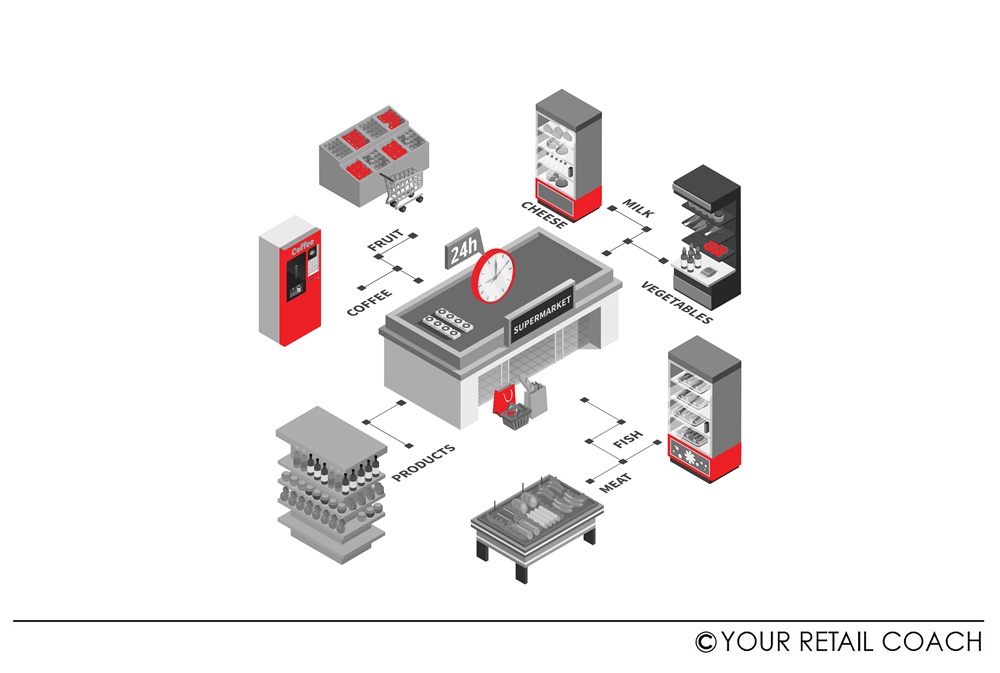
The layout of a grocery store and the associated design of standard operating procedures (SOPs) directly impact customer experience and business profitability. An effective layout uses the store’s interior and aisle location to guide a shopper through the store, allows for greater visibility of products, and promotes impulse buying. Meanwhile, well-defined SOPs and training ensure every staff member executes the SOPs identically, resulting in fewer mistakes and better service.
Good layout planning with solid operational standards leads to predictability in performance among departments. Professionals in retail business consulting often assist grocery stores in aligning space and design with operational workflow to accomplish business objectives. This includes looking at space management, product placement, and moving staff through the store to not only focus on customer convenience, but to improve profitability of the store as well.
Incorporating Business Process Management (BPM) principles into layout and SOPs supports the process of continuous improvement. Coupled with an Enterprise Resource Planning (ERP) system that maintains data accuracy through inventory, pricing and replenishment workflow, the BPM principles ultimately lead to better coordination and decision making.
In any retail setting, whether a conventional grocery store or a multi-channel e-grocery operation in growth mode, applying orderly layout and SOP design improves operational flow, maintains brand consistency, and provides a mechanism for developing a scalable operation driven by business processes which customers can engage with easily.
What is Grocery Store Layout Design?
The configuration of a grocery store signifies how customers will enter the store, traverse the aisles, engage with the products, and develop buying decisions overall. When done right, this design is an amalgamation of both practicality and psychology and, as such, invites shoppers to look into more areas of the store and spend more time inside.
Effective layout design includes:
- Entrance Design: Creating engaging displays to set the tone of the store.
- Flow: Designing a layout that directs shoppers to A-category items.
- Product Location: Positioning high-profit stopping/purchased items in a strategic location.
- Checkout: Designing the billing area to minimize billing completion time with customers.
Retail consulting specialists can utilize several design aspects using different means typically data analytics and customer flow to increase layouts that achieve maximized sales and customer satisfaction. They typically suggest designing store zones where items are positioned based on how frequently they are demanded or how various cross-category impacts other categories. Integration with ERP systems will often allow price setting in real time based on sales data. Then retailers can build, analyze, and modify based on metrics of success compared to layouts.
Ultimately, a grocery store layout is not just in design; it affects customer loyalty, business operation flows, and profits. Every design objective or goal should follow the SOP approach – driven by efficiency – supportive of business metrics with a value-based outcome.
The Link Between Store Layout and Operational Efficiency
Store layout and operational efficiency are closely related. A great floor plan will help reduce congestion, simplify inventory handling, and advance staff movement. Space and staff efficiency reduce trips to storage, shelves, and registers, enabling staff to serve the customer faster.
By employing BPM principles in the plan layout process you can objectively measure results. For each area of the store you can evaluate performance measures such as dwell time and turnover during operations using data from the ERP. That constant feedback can lead to ongoing improvements, just like SOP’s can standardize the way staff replenish products, maintain aisles, and assist customers.
Process automation is another level of synergy, linking point of sale, inventory, and restocking systems. For example, you could have set parameters for when a product sells beyond that limit, automatically generating a replenishment order through the ERP. Retail consultants would often evaluate these processes to diagram what variables produce an optimal balance of how much space to use and how many staff are needed to produce service efficiency.
The bottom line, store layout becomes a physical translation of the operational design. When these plans are coordinated with SOP’s and BPM tools, they create a business-friendly, functional store layout for retail.
Designing Effective SOPs for Grocery Store Operations
The most effective grocery stores integrate a single approach at both physical layout and SOP design. A store layout that is properly designed is beneficial in enhancing the flow of operation, yet in the absence of the related SOPs, even then the operation may fail. Making these two aspects go bosomwise guarantees efficiency in each phase.
Indicatively, SOPs that control shelf replenishment should be aligned with aisle arrangements to reduce the time taken to replenish. Equally, cleaning routines ought to be in line with the customer traffic insights based on BPM. Integration of ERP is crucial since it allows real-time monitoring of stock, sales performance and customer behavior.
The process automation connects the layout and SOPs through the data exchange. ERP systems generate workflow activities when configured accordingly and they take place in accordance with standard procedures. Retail consulting professionals tend to develop cross-functional roadmap in order to match the efficiency in layouts with operational discipline.
Such integration turned the grocery management system that was considered as a fixed system into a dynamic and data-based model. It guarantees that each square meter of space and each action of employees is used to realize quantifiable business development and customer satisfaction.
Integrating Layout Planning and SOPs for Peak Performance
The most prosperous grocery stores make physical plans and SOP plans fall in line with a single course of action. Organised store structure enhances the movement of the operations but without the relative SOPs the execution remains a failure. The alignment of the two ensures that there is efficiency in each phase.
As an example, SOPs that control shelf replenishment should be matched with aisle layouts to reduce the time used in the restocking process. In the same way, cleaning schedules ought to be patterned with the customer traffic based on BPM insight. ERP integration is crucial and ensures real-time monitoring of the stock levels, sales performance, and customer behavior.
The automation of the processes fills the gap between layout and SOPs simplifying the flow of the data. ERP systems can be programmed to activate workflow activities that adhere to standard processes. Retail consulting professionals frequently develop cross-functional road maps in order to match the layout effectiveness with operation discipline.
Such an integration makes grocery management dynamic rather than a fixed system. It guarantees that the square meter of space and every move of every worker will help to quantifiable business growth and customer contentment.
Role of Retail Consulting in Layout and SOP Optimization
Retail consulting provides innovation and design to layout and SOP design through a synthesis of the analytical research and operational knowledge. The consultants evaluate the performance of the current stores, customer traffic, and staff productivity and build new strategies of improvement based on the business objectives.
Retail consulting normally implies:
- Space Analysis: The analysis of aisle usage and traffic movement.
- SOP Development: Development of elaborate operating manuals.
- Technology Alignment: ERP and BPM coordination.
- Process Automation Implementation: Accuracy in repetitive jobs.
- The Performance Tracking: It should be set on KPIs to gauge improvement with time.
ERP systems allow consultants to know the trends in sales and manipulate layouts. They utilize the tools of BPM to track compliance and performance of the employees. Such a twin strategy makes certain that operational improvements are also strategic as well as sustainable.
Retail consulting makes individual changes into strategies. Consultants can help grocery stores to have perfection on both day to day running and scaling in the long term with the balancing of technology, process automation, and staff training.
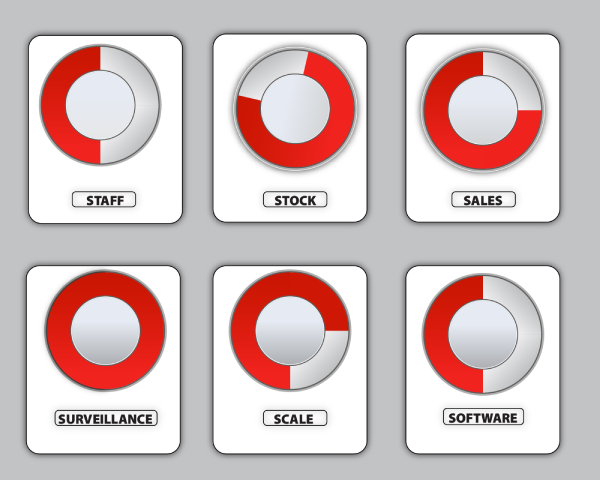
Retail Healthometer
Check the health of your business? Are you ready to organize & scale ?
Author Bio

Nikhil Agarwal
Chief Growth Officer
Nikhil is a calm and composed individual who has a master’s degree in international business and finance from the United Kingdom. Nikhil Agarwal has worked with 300+ retail e-commerce brands and companies from various sectors, since 2012, to define their growth strategy and achieve operational excellence. Nikhil & his team have remarkable success stories of helping brands achieve 10X growth.