
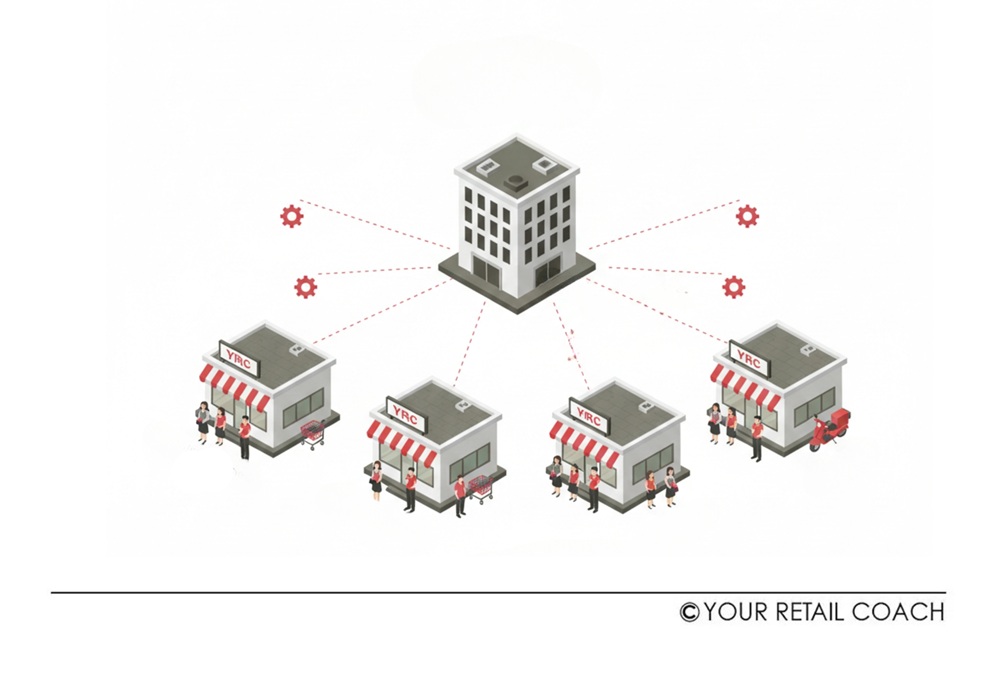
The franchise model enables neighbourhood grocery entrepreneurs to grow quickly, and while retaining a consistent quality and customer experience. The franchise model merges the nimbleness of independent ownership with the rigor of a standardized operating model and shared branding rights.
Retail consulting organizations like YRC create frameworks that encourage grocery entrepreneurs to adopt scalable systems in their business. They leverage the importance of standard operating procedures, automate processes, and align technology so that each franchise is run as efficiently as possible. Through business process management (BPM) and enterprise resource planning (ERP) tools, these frameworks provide owners with the ability to control all data and run reports, enabling them to monitor inventory, sales and compliance even when they are not physically present in the store.
Neighbourhood grocery stores often have a limited number of resources assigned to them, which is why these stores face inconsistencies in personnel management and order management. The franchise model addresses these limitations by providing proven templates to identify the store’s design, merchandising, selling, and staff training practices. Franchisees benefit from the support of experts who provide training, details of their technologies, and tools from their operations that will help those franchisees lessen the costs of attempting trial-and-error methods.
Ultimately, a well-designed franchise model allows grocery stores to retain their local feel while meeting brand obligations, thereby taking leave for a sustainable path to growth at the regional and national level if the entrepreneur desires such opportunities.
Franchise Model for Grocery Stores
Franchise in a grocery is based on the premise of replication. Franchisor offers an established system and franchisees carry out a system on the local level with rigid SOPs. YRC assists in developing such systems to achieve flexibility and operational discipline.
Core elements include:
- Brand Framework: Identity and support of marketing.
- Standards of operation: well-defined SOPs of day-to-day operations.
- Training Systems: Performance control and skills transfer.
- Technology Implementation: Data synchronization ERP and BPM.
- Supply Chain Control: Uniform procurement.
Retail consulting makes these components interact in a coherent way. ERP systems consolidate financial, inventory and logistics information, providing full visibility of the performance of each outlet to the franchisor. BPM tools detect process non-conformity and initiate corrective measures.
The outcome is a functioning ecosystem with all neighbourhood groceries functioning as a smooth machine. Scalability is predictable with standardized systems and quality is not compromised with continuous improvement.
The Role of SOPs in Franchise Scalability
Any successful grocery franchise is based on SOPs. They determine how employees treat stocks, attend to the customers and keep the stores clean. Through elimination of ambiguity, SOPs can ensure that all locations perform in the same way.
The YRC is working towards putting together accurate SOP manuals that will reflect all the activities of the business like order placement and checkout management. It is these procedures that fit the BPM frameworks to enable continuous assessment and enhancement. The use of SOPs in the ERP systems guarantees the accuracy of data and integrity of compliance.
Automation of processes is crucial as it digitalizes repetitive processes like billing and restocking. This minimizes the manual mistakes, decreases the service time and improves the customer satisfaction. Retail consulting specialists help franchise members to adhere to SOPs in a manner that encourages discipline, but not autonomy.
Clear SOPs are mandatory in the franchise model as they are considered the means of quality control and brand recognition. They render growth to be manageable and make every neighbourhood store to provide the same reliable experience that clients anticipate.
How YRC Helps Design Scalable Franchise Operations
YRC utilizes systematic retail consulting practices in scaling groceries franchises. They have expertise that cuts across operation design, technology and performance management to provide a good platform in replication and growth.
Key strategies include:
- Process Mapping: All activities in the stores need to be documented to be clear.
- BPM Implementation: Monitoring operational performance and efficiency.
- ERP Integration: Altering data coordination throughout franchise outlets.
- SOP Development: Developing specific and practical guidelines.
- Automation Planning: Technology to simplify everyday work.
YRC makes sure that every process is dedicated to the business objectives, which are beneficial to the franchises to guarantee consistency in service delivery and cost management. The consulting team analyzes inefficiencies of the processes with the help of BPM tools and proposes improvements that are facilitated by technology.
Franchise partners receive operational independence through a controlled structure through structured training. The strategy of YRC makes small groceries into system-based enterprises that can grow quickly and sustainably at the same time winning the trust and profitability of its customers.
Process Automation as a Growth Enabler
The driver that makes scalability in contemporary grocery franchises is process automation. It lessens the dependency of human beings, speeds up the regular operations, and guarantees the accuracy of real-time data.
Franchise networks begin using ERP software to automate their procurement operations, stock updates, sales tracking, etc. This is complemented by BPM platforms which analyze the performance of the processes and determine their possible bottlenecks. Retail consulting professionals incorporate automation tools that fit in the existing SOPs, which are adopted without hitches.
Automation also ensures that customer experiences are enhanced through reduced check out time, customer loyalty programs and ensuring the prices are accurate. In the case of e-grocery franchises, it allows an easy transition of online-to-offline functions, including the click-and-collect and home delivery.
Through the digitization of back-end and front-end operations, YRC assists grocery businesses to acquire speed without compromising the control. Automation is a way of making sure that the increase in the number of franchise outlets does not increase the complexity of operation and scalability is efficient and profitable.
The Importance of BPM and ERP in Franchise Control
BPM and ERP solutions play a key role in establishing consistency between multiple franchise outlets. The visibility and management capability these solutions bring is part of establishing processes that allow organizations to effectively manage and coordinate operations on a geographical footprint.
The synergies created include:
- Centralized Monitoring: Enables the monitoring of store performance in real-time.
- Process Alignment: BPM would ensure store teams can run to SOP’s and workflow processes.
- Data Integrity: ERP will assure shared records for finance, inventory, etc.
- Informed Decision making: Analytical insights will lead to opportunities to improve performance.
- Strong compliance: Monitor for deviations or errors.
At YRC, we incorporated these technologies when developing franchises into a transparent ecosystem. BPM frameworks and ERP enable the creation of a single source of truth across all functional areas.
Retail consulting teams support training for franchise owners to understand analytics and consider a data-centric decision-making model. Ultimately, a franchise system with early brand standard retention, early identification of performance inefficiencies, and a positive support for improvability through structured process.
Why Neighbourhood Groceries Benefit Most from Franchising
Neighborhood grocery stores are well-connected to their communities but often lack the systems and structure to compete with larger chains. The franchising model gives them an opportunity to modernize store processes while keeping the benefits of being local.
Using YRC’s retail consulting experience, small grocery stores can leverage best practice business models, well-vetted suppliers, and fully-integrated enterprise resource planning (ERP) systems. The standardized and documented operations of a ‘standard operating procedures’ (SOP) guide make assessing the results and the daily operations easier for both owners and senior associates. Equally, the ‘business processes management’ (BPM) tools allow the stores to ensure that each store operates to brand expectations.
Franchising mechanisms also allow the owners to benefit from shared costs i.e. marketing, training, and fewer installations to pay for when upgrading technology. Additionally, process automation replaces manual processes, which increases productivity for store associates. E-grocery also opens up the customer base in combination with the full-service store as a hybrid to increase customers connected to online sales.
The combination of systems and technology allow neighborhood grocery stores to grow within a sustainable structure. They can keep brand familiarity and trust, while achieving operational excellence and growth opportunities that were traditionally reserved for large retailers.
FAQs About the Grocery Franchise Model
How does YRC assist grocery franchise development?
Why are SOP's important in a grocery franchise model?
How does process automation increase franchise efficiency?
What role does retail consulting play in franchising?
Author Bio

Rupal Agarwal
Chief Strategy Officer


Get In Touch