
Emerging Grocery Retail Trends In 2025-26
Grocery retailing will see significant disruption in 2025–26, as digital technology, consumer behaviours, and competitive pressures move rapidly forward. The grocery retailing businesses who are winning – are those who are enabling process automation to run their businesses more consistently, accurately, and with increased customer experience.
The e-grocery business model, data informed decision-making, and integrated advanced ERP systems are crucial. This is why retail consulting firms support grocery businesses in redesigning SOP’s and integrating BPM tools; to ensure process automation aligns with actual execution in the real world.
Modern grocery retailing is made possible by predictive analytics and connected devices, and simultaneous data flows. So we depend upon process automation to further exception handling and improve integration of support services and functions to reduce the human touch, and make process action quicker.
As consumer and retailer needs and expectations rise for convenience, sustainability, and transparency, system driven performance architecture would be supporting the expected consistency across online and offline execution by automation based infrastructure.
By 2026, automated processes will not just be an option to enable operational execution, they will tell which grocery retailers are even remotely competitive in retailing. Grocery retailers who adopt and integrate BPM and ERP systems will be well ahead, through their efficiencies, agility and potential for scalability, collaborating with the continually evolving technology-centric consumer.
Key Grocery Retail Trends Shaping 2025–26
Grocery retail in 2025–26 will reveal the impact of technology advancement on consumer behaviours and additional shopping behaviours. Several defining trends will influence success for modern grocers:
The first couple of major, new trends will include:
Omnichannel Retailing – A frictionless commerce experience in both physical locations and e-grocery.
Hyperlocal Fulfilment – Faster delivery via dark stores or local hubs.
Sustainable Sourcing – Suppliers utilize environmentally sustainable sourcing and supply chains, while customers want to know where their food comes from.
Personalised Shopping – Delivery of personalised offers with data-driven insights and predictive demand analytics.
Automatic Processes – Digital processes that align the accuracy and consistency of grocery retailers as subprocesses throughout the supply chain.
Helping grocers in making these changes will be retail consulting experts building scalable systems that are founded on BPM principles. Little can automate processes the way a standard operating procedure can ensure the consistent process as grocery stores transition to hybrid operational models.
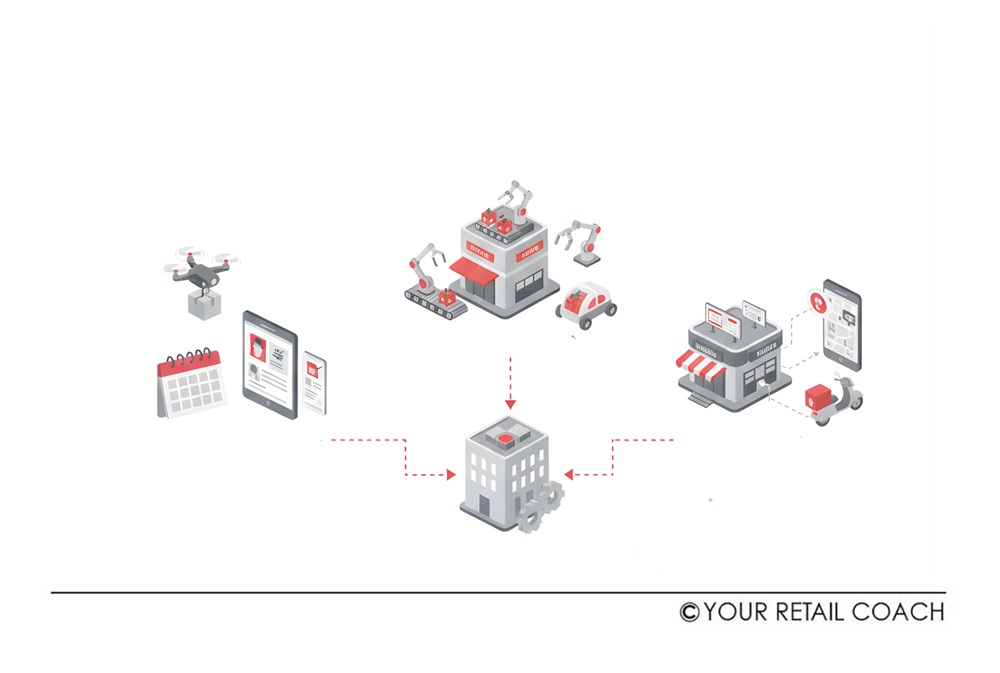
All of these will be achievable through using ERP systems to consolidate all sales, inventory and supply supplier data to give grocery retailers a single report on the business to enable more informed decisions.
As competition grows between food retailers, those that can automate their operations and consistently leverage data will raise the bar for all food retailers, while they will also be able to raise operational excellence with best of breed options.
Why Process Automation Has Become Essential
Process automation in grocery is no longer an operational choice – it is a strategic necessity for grocers competing in 2025-26. Automation reduces manual tasks, removes duplication, and provides teams the space to focus on customer experience rather than administrative tasks.
Retail consulting experts express the importance of automating in conjunction with standard operating procedures to maintain control while also capturing efficiencies. BPM software includes automated workflows that ensures consistency across departments.
With e-grocery operations, automation speeds the order fulfillment processes, improves order accuracy, and keeps live inventory data across channels. Integrating process automation with ERP systems drives together financial performance, operational data, and supply data to provide real-time insight.
By employing automation to their operations, grocery retailers create better visibility on performance metrics, reduce costs, and improve resource effectiveness. Businesses that are early investors in process automation create agile structures that can leverage an opportunity to scale quickly. In the end, process automation in grocery has become the distinguishing capability between efficient, future ready retailers and retailers that just do not have the capacity to adapt.
How Retail Consulting Shapes Automation Success
Retail consulting has an important role to play in facilitating grocery trade adoption of automation. Consulting experts will evaluate their operational workflows, develop structured standard operating procedures (SOPs), and determine where business process management (BPM) and enterprise resource planning (ERP) integration produces the most impact.
Automation Strategizing via consulting services would include:
Process Mapping: Identifying workflows that are repetitive or manual and should be qualified for automation.
SOP (Standard Operating Procedure) Development: Documenting step-by-step processes for standardization purposes.
BPM Integration: Creating visibility across digital workflows.
ERP Connectivity: Ensuring data is changed in real-time and connected to the process.
Performance Monitoring: Measuring efficiency and cost impacts within the workflows and automation process.
Working with retail consultants will achieve process automation that stays in line with business goal and is not just disconnected technology. Consultants, through facilitation, will help develop an understanding of defined roles, established governance structures, and how this aligns with accountability.
Grocery chain retailers would be able to successfully implement automation by developing SOPs so the process is much smoother and adopted faster. Consultant facilitation allows for re-definition and planning that turns the automated process from a technical upgrade to a growth enabler – ultimately supporting scalability and profitability.
The Rise of E-Grocery and On-Demand Models
The e-grocery industry is undergoing rapid growth throughout 2025–26, driven primarily by consumer needs for convenience, speed, and accuracy. The automation of processes allows these services to be efficient under increased levels of demand and at scale.
Order picking, order tracking, and scheduling of delivery tasks, which are all automated, reduce errors and shorten service cycles. Business process automation (BPA) platforms, which can facilitate end-to-end processes, ensure accurate compliance with standard operating procedures (SOPs) across stores, warehouses, or dark stores.
Consultants in retail have suggested integrating enterprise resource planning (ERP) into grocery technology for improved real-time visibility of orders, stock levels, and, ultimately, suppliers. This integration can help to diminish cycles of disruption and minimize the risk of stockouts.
As e-grocery models expand into instant delivery and subscription-based delivery models, the automation of processes allows for discreet coordination between layers of the service. From demand forecasting processes to route optimization processes, the industrialization of automation enhances both operational dependability and customer satisfaction.
By leveraging an underlying BPM framework, grocery retail will have systems that can retain the speed and accuracy, and importantly profitability, needed to play in the ever-changing e-grocery competitive environment of 2025 and beyond.
ERP and BPM Integration
At the core of grocery automation is the combination of ERP and BPM systems, which enables a unified operational system that tracks all tasks, transactions, and metrics digitally.
Benefits of integrating ERP and BPM include:
- Centralized Data: A single version of the truth in both financial and operational records.
- Real-Time Monitoring: Continuous updates on stock levels, sales, and logistics.
- Automated SOP System: Guaranteed compliance through digitally automated workflows.
- Improved Coordination: Enhanced visibility between departments.
- Scalability: The ability to duplicate successful processes across locations.
The implementation of such systems for grocery organizations is supervised through retail consulting professionals to ensure compatibility as they come together. Ultimately, automation supports not only efficiency but also decision making.
By implementing ERP and BPM together, grocery organizations can manage their supply chain, financials, and performance metrics holistically. This system provides transparency, continuously updated information, and agility, which are essential elements upon which any successful modern retail organization must build.
Redefining Workforce Roles Through Automation
Automation does not eliminate grocery employees, but rather shifts their job duties to people creation. With the automation of repetitive tasks through BPM and ERP systems, people can now contribute their efforts to higher value work, such as engaging with customers and strategizing.
Retail consulting assists retailers in redeploying staffing roles and retraining on new standard operating procedures (SOPs.) Since automation reduces administrative overhead, the team can focus on ways to improve customer service.
For example, in e-grocery environments, automatic processes can manage inventory replenishment so that employees can focus on delivering personalized assistance and solving problems for customers. Automating processes also allows accountability with measurable performance dashboards.
BPM systems allow organizations to be able to track accountability if compliant with the task and know the right training should be provided. With staff in the grocery workforce becoming accustomed to their new roles, productivity increases, and morale improves. Grocery business organizations can find work to be a leaner, smarter operational model where human execution becomes more efficient with digital technology.
FAQs About Grocery Automation and Retail Trends (2025–26)
In what ways is process automation affecting grocery retail in 2025–26?
How does retail consulting impact grocery retail automation?
What is the value of ERP systems in e-grocery?
Author Bio

Rupal Agarwal
Chief Strategy Officer


Get In Touch