
Designing SOPs For Online Retail
Standard Operating Procedures (SOPs) provide an ability to scale. In e-commerce, SOPs ensure greater consistency in the quality of core processes. This includes things such as listing products or confirming successful delivery.
SOPs help maintain compliance by monitoring issues such as fraud, data governance, and financial reconciliation. SOPs make possible the automation, AI-driven optimisation, and performance analytics on which so much industry attention is focused. Once static documents, SOPs are now dynamic and evolve with changes in customer behaviour, regulatory requirements, and new platform features.
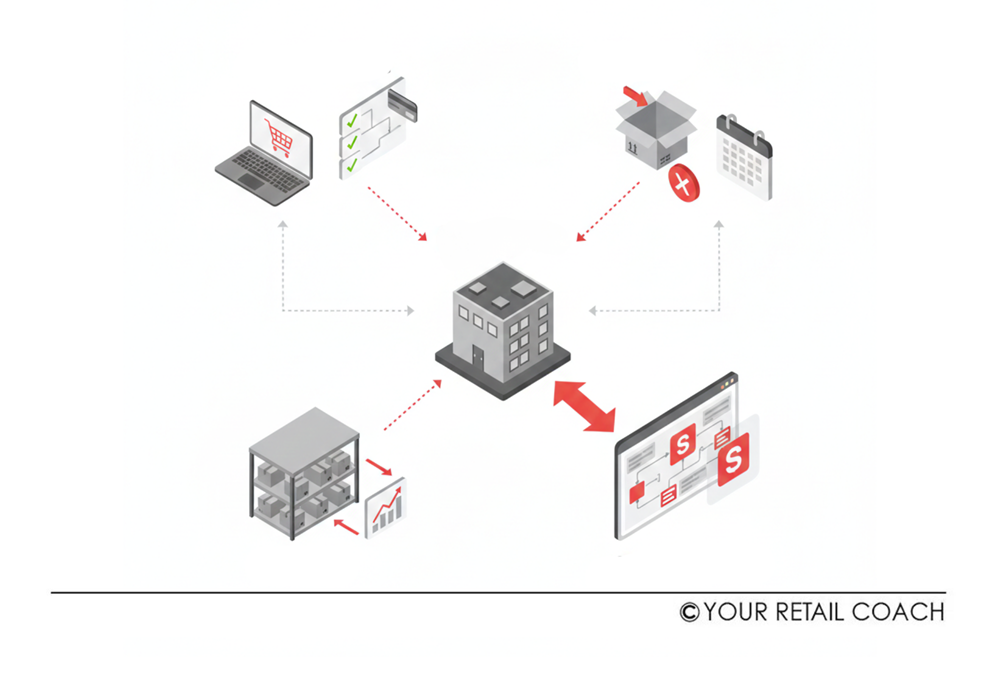
In conjunction with Business Process Management (BPM) platforms such as Signavio, brands can map and simulate as-is workflows and implement improvements on an ongoing basis. The better the SOPs are, the easier it is for customers to receive what they desire and ultimately remain a loyal customer.
Designing Checkout Flow SOPs
A checkout flow must be fast and optimized for conversion. Structuring the checkout SOP ensures the process performs reliably across devices, payment types, and user segments.
Important Parts of a Checkout SOP:
- Customer entry paths: rules for guest checkout, registered user flows, social login, express checkout, and one-click payment logic.
- Form data policies: rules for checking the validity of addresses, phone numbers, email formats, autofill settings, and international fields.
- Payment orchestration includes routing logic for gateways, retry mechanisms, fallback payment options, BNPL rules, fraud checks, 3DS triggers, and tokenisation standards.
- PCI-DSS documentation, rules for minimising data, and guidelines for safe storage are all examples of security and compliance.
- An optimisation framework includes SOPs for A/B testing checkout variants without affecting live performance, as well as requirements for logging and analytics.
- A well-written checkout SOP increases sales, lowers the number of support tickets, and makes sure that performance is always the same, even when traffic spikes.
Building Returns and Reverse Logistics SOPs
Returns are an essential part of eCommerce, especially for clothing, accessories, electronics, and home products. Optimizing the returns SOP fills the gap between making it easy for customers and keeping costs as low as possible for the operation. It’s wise to start by articulating who is eligible to return an item and under what conditions, what the condition of the item needs to be, and what the packaging needs to look like along with what is not eligible, such as certain health and safety products.
The returns SOP needs to illustrate how customers have the opportunity to initiate the return process, via portal, guest-return module, chatbot, or customer service representative. The information should also state what type of communication with the customer exists at every stage including confirmation emails, return shipping label email, reminder emails, and the refund email.
Working toward the warehouse teams, presentation within the returns SOP needs to be simple and direct stating either check, grade, fix, quarantine, or throw away once it is in the reverse logistics pipeline. It may also state how to check to see if a product can be resold, restocked, sold off, etc. The same must happen with money. Refund timelines, reconciliation processes, fraud detection and verification, as well as partial refunds.
Clear communication between logistics partners, warehouse staff, finance teams, and customer service teams makes sure that returns go smoothly. When returns are done right, they don’t just cost money; they also build customer loyalty and give you data-driven insights into product quality and delivery problems.
Inventory Management SOPs for Digital Commerce
Inventory accuracy tells you how well an online store can fill orders. The inventory management SOP should make sure that sales channels, warehouse systems, and forecasting models all work together.
The main parts of an inventory SOP are:
- Real-time synchronization: frequency of inventory updates, buffer stock rules, overselling rules, and API monitoring rules
- Picking/packing standards: workflow sequencing rules, locations for bins, batching rules, and consequences for missing items.
- Cycle counting and audits; for daily and weekly action items, thresholds for differences, and reconciliation workflows.
- Demand forecasting integration; to include past data; demands seasonality, promotional planning, and projections from algorithms.
- Stock-out and replenishment protocol: rules for notifying suppliers, replenishment cycles, and safety stock maintenance.
- Returns integration: standard operating procedures (SOPs) for inventory restocking of returned items, grading conditions, then tracking how many items remain for sale.
Accurate inventory SOPs have an impact on customer satisfaction; it ensures that stock is available, deliveries are timely, to facilitate business operations.
Journey Mapping for Online Retail Excellence
Journey mapping illustrates how customers interact with a brand at the discovery, purchase, fulfilment, and post-purchase points. Journey mapping indicates who does what, how systems interact, what customers are feeling, and how handoffs occur in processes. A comprehensive online retail journey map highlights touchpoints like entering the homepage, searching for a product, interacting with the PDP, reviewing the cart, checking out, making a payment, confirming the order, tracking delivery, and making returns.
With each touchpoint, you can identify problems, like friction, latency, and failure. As you are building a journey map, it is important to think about different people, such as a first-time shopper, loyal customers, and international shoppers, and what they are expecting and needing. Having this information helps a standard operating procedure writer ensure that each internal step makes sense with a customer’s experience so that all internal back-end processes help the customers’ front-end experience.
When you combine a comprehensive journey map with other analytical data like web analytics, heatmaps, behavioural tracking, and VOC data, the journey map transforms into a blueprint of what the current process looks like, which means that the teams can use this information to redesign the processes and everything starts to come together.
More importantly, the journey map becomes a tool for facilitating cross-disciplinary teamwork. Marketers, UX, operations, and engineering can all see how the workflows of various processes either help or hinder important aspects of customer satisfaction and frustration. Ultimately, journey mapping reframes the standard operating procedure (SOP). Instead of an SOP to instruct how to run a business, it becomes an SOP that focuses on the customer experience.
Signavio BPM and Process Mining Insights for E-Commerce
Signavio gives you the modelling, collaboration, and analysis tools you need to turn SOPs into flexible, always-improving frameworks.
How Signavio Makes E-Commerce SOPs Better:
- Process modelling: visual representations of checkout flows, inventory movement, refund cycles, and fulfilment operations that help with alignment and documentation.
- Process mining: This mechanism is all about the use of event logs to find real-world deviations from standard operating procedures (SOPs).
- Collaboration hubs: These let people from different departments work together to create SOPs, give feedback on drafts, and make sure that workflows are the same across different units.
- Governance frameworks: keeping track of versions, audit trails, and compliance paperwork for online businesses.
Integration with KPIs means linking the performance of a SOP to metrics like the conversion rate, return rate, order accuracy, fulfillment speed, and cost per order.
Retailers create a cycle of continuous improvement that drives digital commerce process optimisation by combining SOP documentation with process mining insights.
FAQs
Why are SOPs necessary in online businesses?
How does Signavio BPM assist with the optimisation of e-commerce operations?
What does a checkout flow SOP include?
How do SOPs aid inventory accuracy in e-commerce?
What makes journey mapping so important for making SOPs?
How does process mining help online stores keep getting better?
Author Bio

Rupal Agarwal
Chief Strategy Officer


Get In Touch