
Picture a successful entrepreneur with two quotes in front of him. One of them is for a beautiful location on a busy avenue, and the second one is for a basic premises in the back street that guarantees a very low level of walk-ins.
The first location is really appealing, as it offers a transparent store-run and many people passing by. Meanwhile, the second option seems mediocre, but requires on much less rent and is able to work for customers in many other areas. While both proposals seem extremely logical, they lead to completely different types of businesses.
A lot of retailers are wondering this question these days. And there is no single answer to it. The right model varies depending upon many factors including what you sell, who you are selling to, and the daily operational pressure that your staff can withstand.
This blog compares the two models in terms of cost, business model, and profitability.
What Each Model Really Means
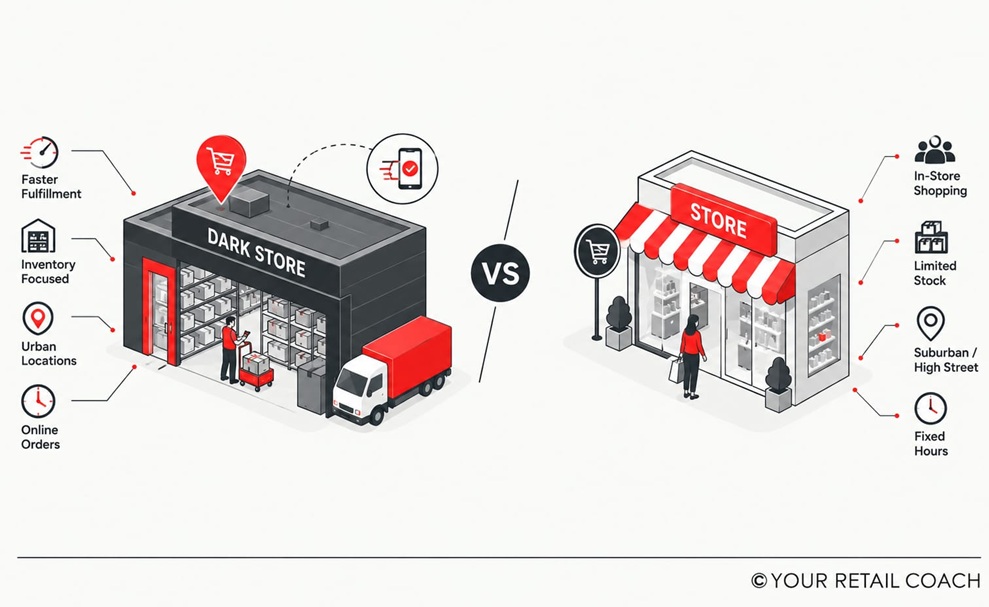
A traditional store is the one we all know. When people enter the classic shop, they touch the goods, interact with the salespeople and pay for their purchase at the checkout. This business is effective not only as a point of sale but also as an advertisement due to its location, its display and the people in it who influence the buyers.
On the contrary, a dark store operates differently. It is rather a small fulfilment centre which is closed for occasional customers and is mainly designed for packing and mailing the goods ordered online. There are no shelves or queues and the whole layout is designed in accordance with the speed of the picker.
Those who compare dark stores to retail stores often see them as an opposition of the past and the future, while in reality they are two ways to reach the same customer.
The Dark Store Business Model
The dark store approach is based on repeat customers, not on physical traffic. Profits are generated by the orders’ basket value, which must be high enough to pay for picking, packing and delivery.
Ways For Generating Revenue: The product margins on orders will form the bulk of revenue, with some amount coming from delivery and handling charges.
Order Patterns: Orders come in waves at the times of day when service potential is higher, meaning that staff levels and stock cannot be fixed in a straightforward manner.
Reliance on Density: The model is most likely to be successful when there are a high number of clients living in the same area, since spreading clients around will lead to longer time spent traveling by the riders and higher delivery costs.
Dark Store Cost vs Traditional Store Cost
Dark store cost is not simply lower than a shop, as many people believe. The cost only moves from one place to another. A traditional store spends heavily on rent, fit-out and in-store staff, while a dark store spends more on technology, riders and tight inventory control.
Rent and Location: A store situated in a prime location has to pay more in order to benefit from the visibility and foot traffic. A dark store can be located in an alley or on an upper floor as there is no need to look for it. Thus, the rental costs are generally lower, though access to a good road and parking for drivers remains essential.
Fit-Out: Conventional shops require appealing displays and lightings while dark stores require shelves, chillers and scanning devices. The expenditures on such activities tend to be lower.
People: Retail stores need salespeople for face-to-face communication with customers, while dark stores need a turnaround of quick pickers and packers.
Delivery and Technology: This is the heavy part for a dark store. Rider cost, order software, inventory systems and customer app support all add up every month, whereas a traditional store gets this work done free of cost because the customer comes by themselves.
So when you check the dark store cost, look at the cost per order and not only at the monthly rent.
Dark Store Profitability
Dark store profits will take longer than 30 days to arrive, something that many first-time owners don’t seem to understand. You need at least a minimum number of orders to cover expenses and this requires marketing and a well-thought-out assortment.
Order Volume: More orders in the same area bring down the delivery cost of each order. A store with only a handful of orders will struggle however good its layout is.
Basket Size: The addition of even a few items results in a delivery trip being much more efficient, making it possible to make use of bundles, combinations and propositions at checkout.
Utilisation: Because staff and facilities are paid full-time, orders can not be expected to arrive day long, so idle time is also used to get ready for future orders, to restock and count.
Wastage and Errors: Wrongly sent products, orders taking too long to come and expired products get to the stage of refunds and refunds do make for a decline in profits.
A traditional store follows a different logic. Its profit depends on how many visitors actually buy something and how much is sold from every square foot against the rent paid, and a poor location can never be fixed by good staff alone.
Which Model Fits Your Retail Brand?
There is not any single clear cut answer or remedy for the conundrum of whether to set a dark store. However, some issues could serve as helpful guidelines for the development of your own vision. The first point to consider is the product you offer.
Commodities that are needed on a consistent basis, such as foodstuffs, medicines and other daily necessities, should respond better to the dark store model than goods that people need to see, touch and compare, something like furniture, jewelry or modes of fashion.
The next part is the customer’s needs. If they live relatively close to the dark store, it would be a good solution, but if a customer base is situated far, online shopping with longer delivery options will prove to be more beneficial for all parties involved.
Finally, be honest about your team, because a dark store runs on discipline and daily numbers, and not every business is ready for that pressure.
The Hybrid Route
Most brands are free to reserve their official positions. You can open an online store with the help of your existing retail outlet. It means that you can work out online orders in your retail store. Thus you check the demand and are able to learn the real expenses without making a significant investment. If you get a good number of orders, you can set up a dark store in that area.
This step-by-step method is safer than starting a large dark store on assumptions, and customers can still see and try your products in the shop.
Mistakes Retailers Make While Choosing
Riding the Wave: Some entrepreneurs open up a dark retail establishment just because the idea is currently fashionable, without determining if their merchandise is compatible with the model and customers.
Blindly Considering Rent: Looking at the comparison of the two formats only through rent gives a distorted view, since the aspects of delivery and technology can completely alter the outcome.
Neglecting Brand Experience: A brand that relies on touching, testing, and chatting may lose its identity if it switches to the dark format.
How Retail Consultants Can Help
Taking this decision on gut feeling can be costly. A good retail consulting partner studies your catchment, builds a cost and break-even model for both formats and tells you which one makes sense for your brand at this stage.
About YRC
Your Retail Coach (YRC) is a trusted retail and business consulting firm. It helps brands compare store formats, build cost and break-even models, and plan dark store operations that work. Its practical, hands-on approach, deep ground-level experience and focus on measurable results help retailers choose the right model with confidence.
Retail Healthometer
Check the health of your business? Are you ready to organize & scale ?
Author Bio

Nikhil Agarwal
Chief Growth Officer
Nikhil is a calm and composed individual who has a master’s degree in international business and finance from the United Kingdom. Nikhil Agarwal has worked with 300+ retail e-commerce brands and companies from various sectors, since 2012, to define their growth strategy and achieve operational excellence. Nikhil & his team have remarkable success stories of helping brands achieve 10X growth.