

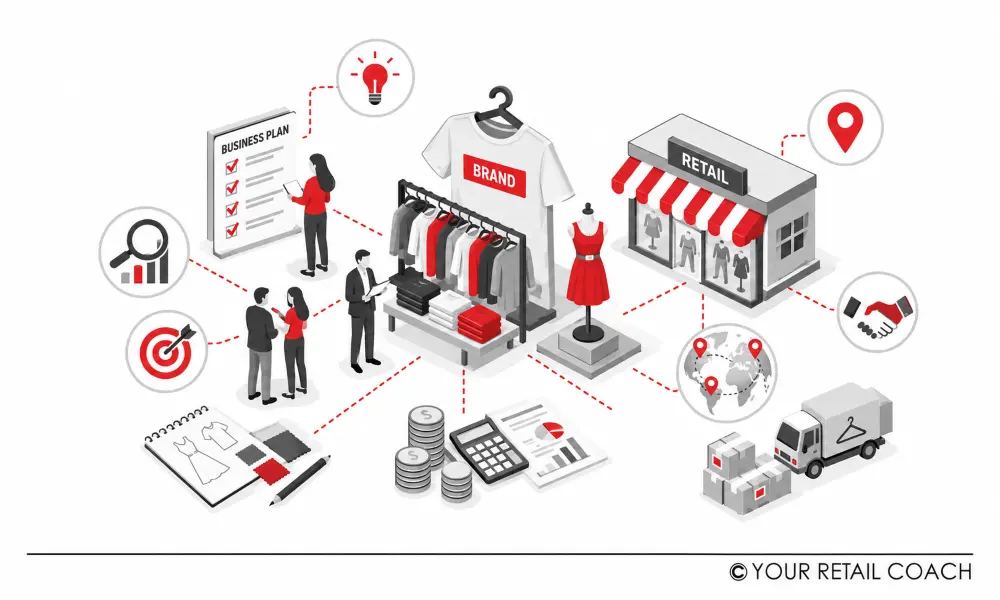
When developing a clothing brand business plan aiming to attract potential investors or retail business partners, you need to go past the creative flair and focus heavily on scalability, operational excellence, and commercial viability. You have to be well-versed with how investors and retailer partners scrutinise a business plan for evaluating the prospects of investing and associating.
In this blog, our experienced team of fashion business plan consultants have encapsulated their insights on business planning into ten segments for better comprehension and adaptability for application.
(1a) Unit Economics
Unit economics is the product-level analysis of associated revenues and costs.
What You Should Focus On and Why
- Fabric and Trim Costs (Fabric can account for up to 70%* of apparel manufacturing cost. Buying fabric in small/retail batches is commercially unsustainable)
- Cut, Make, Trim (CMT) Wage Rates (Extremely low wage projections could be seen as the involvement of unethical labour practices or reliance on overseas sources that often come with supply chain volatilities)
- Freight, Duties, and Tariffs (Are these additional expenses accounted for? These heads can add another 15%-20%* to the cost of an apparel item)
- Wholesale and Retail Markup (Ideal wholesale price to manufacturing cost ratio is 2x*, and the ideal MSRP to wholesale price ratio is also 2x*. Significant deviations from the ideal standards may not be viewed positively by prospective investors and retail partners)
- MOQ Risks (Is a good unit cost achievable only at high MOQ levels? High MOQ risk creating overstocking leading to higher working capital requirements)
(1b) Contribution Margin (CM1)
Contribution Margin 1 (CM1) measures the revenue margin left after covering COGs and costs of fulfilment (packaging, shipping, logistics, etc.).
What You Should Focus On and Why
- Ability to cover fixed costs (healthy CM1 is 60%-65%* for retail apparel industry)
- Runaway for marketing spend (higher is better, must leave room for desired profits)
- Throws light on hidden transactional and logistical expenses (should be assessed earlier)
- Room for markdowns and returns (seasonal sales, returns are high in apparel retail)
(2a) Inventory Velocity
Inventory velocity measures how fast a brand is able to sell its stock.
What You Should Focus On and Why
- Cash-to-Cash Cycle Duration (Shows how the frequency of “how soon” revenue is available for re-investment)
- Presence of High-Velocity Bestsellers (Provide revenue certainty as against reliance on a few unpredictable and seasonal hits)
- Reorder Lead Times for Bestsellers (Reliability and agility of sourcing, production, and supply chain factors for maximising the returns from best-selling merch)
- Past Inventory Turnover (Healthy inventory turnover in the apparel retail industry is 7-8 times*. Anything less than could be construed as marketing issues)
- Logistics Velocity (Affects the ability to fulfil warehouse and store requirements)
(2b) Sell-Through Rate (STR)
A high STR is an indication of strong market demand, customer preference, and the efficiency of inventory movement and supply chain management.
What You Should Focus On and Why
- Full-Price STR (A healthy STR benchmark is 70%-80%* at full price. High sales but only under discounted pricing raises questions on the ability of merch in their original tags)
- Cleardown and Markdown Strategies (The blueprint for stock clearance, necessary for freeing up working capital)
- Granular SKU Rationalisation (To check revenue and margin loss because of overemphasis and under-emphasis within SKU variants)
- Sell-Through Protection (The availability of RTV (Return-To-Vendor) protections and markdown support options for unsold merch)
- Demand Forecasting System (How scientific and reliable are the demand projections? What tools and technologies are used here?
(3a) Supply Chain Resilience
Supply chain resilience is checked to evaluate the ability to endure jolts, adapt to disruptions, and uphold a stable flow of inventory, without massive deferrals or cost escalations.
What You Should Focus On and Why
- Geographic Diversification (Complete reliance on a single supplier or a handful from the same region makes sourcing vulnerable to environmental risks)
- Control over Raw Material Sourcing (Enhanced exposure to quality mismanagement and supply chain disruptions)
- Backup Arrangement with Vetted Suppliers (risk minimisation, continuity, quality control, cost protection)
- Quality Assurance (QA) and Quality Control (QC) (The system of gates and checks for quality management)
- Tech-Powered Visibility (For monitoring and ensuring a smooth flow and availability of inventory, minimise scope of shrinkage)
- SLA Management (enforcing quality protocols, lead time standards,
loss protection, exit)
(3b) Minimum Order Quantities (MOQs)
MOQs influence working capital requirements and the risks associated with inventory.
What You Should Focus On and Why
- MOQ Breakdown (Because of individual MOQ requirements for style, colour, and size, retailer partners might end up with excess overall inventory)
- Upfront Working Capital Requirements (High MOQs translate into high upfront payments, which can make the deal unfavourable)
- Shadow Inventory and Dead Stock (There should be a strategy and mechanism for absorbing or liquidating unsold stock before it begins becoming a financial burden)
- Impact on Warehousing and Pricing (High MOQs leading to excess inventory presence eventually puts stress on warehouses and forces retailers to go for discounted pricing)
- Flexible MOQ Tiers (Is there a possibility of coming up with flexible MOQ tiers that would help retailers strike a balance between high-selling bestsellers and experimental merch?)
(4) Direct-to-Consumer (D2C) versus Wholesale Split
Striking a balance between D2C and wholesale channel distribution and protecting both channels is critical for the confidence and success of retail partners as well as of the host brand.
What You Should Focus On and Why
- Channel Split (A sustainable division is an equal split between D2C and wholesale distribution, sometimes with higher inclination towards the wholesale channel)
- CAC-to-CLV Ratio (Ideal benchmark is CLV being 3-4 times* of CAC, higher the better)
- Pricing Protection (Internal and external channels cannot enter into competition, there should be a strong policy and compliance track record, if possible)
- Credit Terms (Without favourable credit terms with suppliers and buyers, time lags occur between inflow and outflow of funds, capable of bringing operations to a halt)
- Channel Exclusive Merch (Protects both the channels, prevents cross-channel competition)
(5) Return Rate Mitigation & Technology Integration
The right tech solutions can drastically bring down return rates, serving as a very strong UVP for a business system.
What You Should Focus On and Why
- Merchandise Fitment (Technological solutions can interpret vital statistics into a multi-dimensional profile, helping in the determination of right SKUs)
- Augmented Reality and Virtual Try-On (visualisation in applied form using rendering technologies)
- Incentives for Non-Bracketing Behaviour (Forcing customers is not a good idea, reflects a better understanding of consumer behaviour and customer experience)
- Risk and Non-Risk Profiles (Not to treat all segments of customers the same way, increases the CLV of sensible customers)
- Refund Without Return (In non-exchange cases, intelligent systems can determine if it is profitable to refund to customers without collecting the order back)
(6) Product Development Cycle & Time-to-Market (TTM)
When developing a business plan for clothing brand, demonstrating speed and agility of the business model assumes critical importance.
What You Should Focus On and Why
- Concept-to-Shelf Timeline (A clear, objective, and visual representation of the production calendar, not extending beyond 3 months*, the shorter the better)
- Digital Sampling and Prototyping (3D sampling shrinks the prototyping timeline down to hours or days, instead of weeks consumed by the physical route, slashes costs and is more sustainable)
- Greige Fabric Buffer (This involves committing to bulk purchases from mills but procuring only in small batches, inventory stays with mills, quicker time-to-market)
- Integrated PLM (Tech packs and other communication systems sync directly with the suppliers’ or manufacturer’s tech systems, prevent miscommunications, updates real-time, reduced scope of human errors)
- Test and Scale Framework (Allows testing new designs at small scale, optimises risk)
(7) Brand Equity & EEAT SEO Strategy
What You Should Focus On and Why
- Verifiable Experience (Integration of first-hand and tangible evidence of experience in web content)
- Credentials of Authors and Business (Bio of founders, registered office addresses, social media handles, industry affiliations, certifications and licenses, recognitions, etc., essential for establishing authority and building trust)
- Niche Topic Coverage (Structured content that demonstrates subject matter expertise, made comprehensible to average readers)
- AI Engine Optimisation (Content curation for AI engines, for OTG answers)
- Backlinking (From trusted and relevant sources serve as strong brand validation)
(8) Use of Funds & Scalability Milestones
Investors are not just interested in the destinations of funds; they also want to see what milestones, speed, and capabilities are unlocked by such utilisation of funds.
What You Should Focus On and Why
- Inventory Purchase (For the most efficient use of funds invested into the purchase of inventory based on velocity, investors do not want their money stuck in inventory for long, contributes to funding expansion internally)
- Improvement in Unit Economics (Earmarking of funds for supply chain optimisations such as better MOQ deals, for lowering cost per unit, CM1 needs to be safeguarded when scaling)
- Healthy CAC and CLV (CAC is also an investment that demands ROI, investments must be backed up with proven strategies and data, healthy CAC-CLV ratio is 1:3 i.e. 3x return, a poor ratio would only amplify the woes after expansion)
- Tech Stack for Operational Excellence (Investments into tech stack should exhibit improved operational performance and capabilities, should be able to handle complexities and higher business volumes)
- Transitioning to Multi-Channel or Omnichannel (Adding more channels via reliable systems is a prime scaling strategy in retail, investors/retail partners want to see efforts and outcomes in that direction)
(9) Current Retail Footprint & Partnership Terms
In a fashion business plan, retail partners and investors want to see how the brand’s business model fares in the heat of the real backend and front-end environment.
What You Should Focus On and Why
- Unit Economics of Existing Stores (prospective investors and retail partners need proof of self-sustenance and attractive profitability of each of the existing stores on its own merits, otherwise it would be the amplification of commercially dubious physical storefronts)
- Footprint Concentration (It creates room for superior managerial, supply chain, and operational efficiencies)
- Margin “big enough for two mouths” (Sufficient gaps between COGS, Wholesale Price, and MSRP are necessary for a mutually-thriving commercial association)
- Markdown Support and RTV (The risks and costs of dealing with unsold inventory should not be forced upon retail partners or franchisees)
- Territorial Exclusivity and Omnichannel Radii (To prevent internal, cross-channel competition)
(10) Financial Projections & Cash Flow Runway</2>
An apparel brand can go broke even at its peak sales if the brand is not particular about its cash flow projections – something that determines survival and the ability to fund scale.
What You Should Focus On and Why
- Cash Conversion Cycle (If the time lag between cash payment and cash receipts for the host brand is not well accounted for, a commercially viable deal with retail partners is never feasible in the first place)
- Fully Loaded COGS (Margins would be flagged as falsified if the costs of fulfilment (packaging, shipping, and logistics are not accounted for in CM1)
- Reality of CAC with Scale (CAC tends to go up as brands scale and are required to convert “increasingly rigid” consumer behaviour)
- Reality of Actual Payment Practices (Brands must take into account the commonly practised payment cycles along with provisions for bad debt and chargebacks)
- Worst-Case Scenario Projections (Fall-back mechanism and response plan, emanating from supply chain disruptions, drastic fall in demand, internal failure, etc.)
How It Works
How to design a fashion business plan that attracts venture capital funding?
Answered by apparel business plan specialists…..suits clothing brand startup business plan
Step 1: Begin with a sharp executive summary
- Hook (white space, solution, UVP)
- Omnichannel and margin strategy
- Operational blueprint
- Financial runway
- Capital ask and milestones
Step 2: Define the brand and business model, touching the critical aspects
- Core identity and market positioning
- Margin and pricing architecture
- Channel and distribution split
- Supply chain and agility model
- Customer acquisition and retention engine
Step 3: Prove the availability of specific market space
- Verifiable financial trends (e.g. increasing repeat-purchase rates)
- Third-party validation (e.g. secured franchise territory agreements)
- Declining CAC and rising CLV
- TAM-SAM-SOM breakdown
- Unaddressed White Space (e.g. long lead times)
Step 4: Present the brand’s unique strengths and advantages
- Exclusive margin architecture
- Compacted lead times
- Digitised reverse logistics shielding
- Insulated search and content authority
- Exclusive supply chain partnerships
Step 5: Showcase a realistic go-to-market strategy
- Phased omnichannel rollout
- CAC to LTV Projections
- Return prevention tech stack
- Hyper-local marketing strategy
- Inventory and lead time alignment
- Present NSO framework
Step 6: Present a robust operations framework
- Process-orientation (SOP-based operations)
- Tech Stack (e.g. predictive forecasting, use of RFID in logistics, process automation, virtual try-on, POS and ERP integration, retail tech localisation, AR/AI integration,
- Application of KPIs for operations and performance management
- Audit mechanisms, control tower model
- Regulatory and vendor compliance
Step 7: Present a realistic and fully-planned financial vision
- V-shaped cash conversion flow
- Projections (Income and expenditure, balance sheets, and cash flow statements)
- Segmented contribution margin (CM2)
- GMROI and inventory velocity metrics
- Stress-tested scenarios
Step 8: Accurately state funding requirements
- Capex and Opex split
- Cash conversion timelines
- Roadmap for fund utilisation
- Burn rate and runway duration
- ROI metrics
Step 9: Highlight risk mitigation measures
- Fabric staging for supply chain disruptions
- Liquidation channels for stock obsolescence
- EEAT leverage for CAC spikes
- Tech shielding for high return rates
- Stress-testing for working capital crisis scenarios
Step 10: Attach supporting materials
- Third-party agreements and orders, SLA contracts and quotes
- Historical metrics and trend analysis (CCC, CLV, CAC, STR, turnover and velocity, etc.)
- Audit reports by certified external professionals/firms
- Regulatory and compliance copies
- Industry-level associations, certifications
Disclaimers
** The content shared under these sections is limited in nature and is only for informational purposes. For practical purposes, we recommend the consideration of availing professional business plan consulting services and solutions.
Retail Healthometer
Check the health of your business? Are you ready to organize & scale ?
Author Bio

Nikhil Agarwal
Chief Growth Officer
Nikhil is a calm and composed individual who has a master’s degree in international business and finance from the United Kingdom. Nikhil Agarwal has worked with 300+ retail e-commerce brands and companies from various sectors, since 2012, to define their growth strategy and achieve operational excellence. Nikhil & his team have remarkable success stories of helping brands achieve 10X growth.